AI Doesn't Live in Your Head: My Conversation on the Take It To The Board Podcast
TL;DRShort Answer
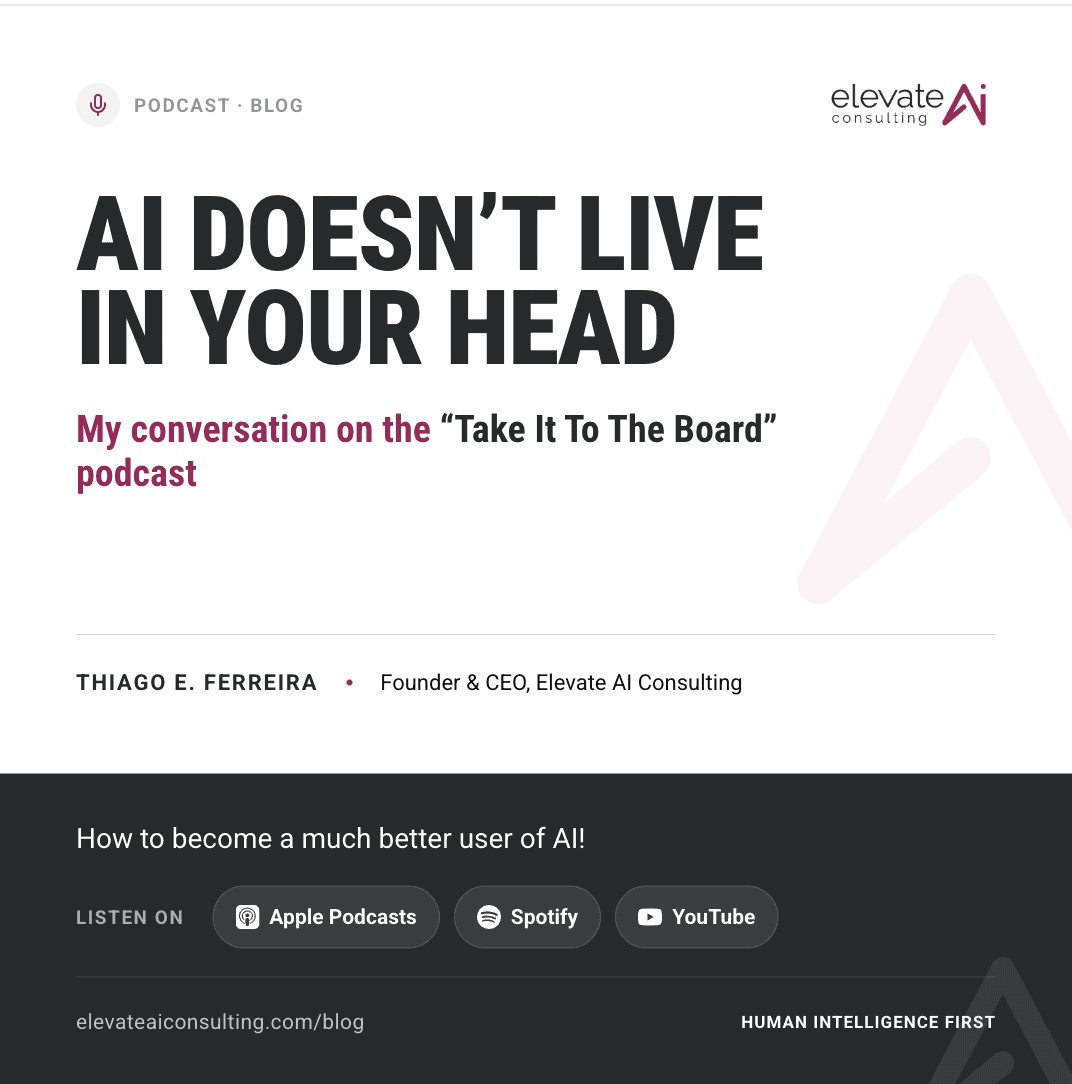
- Thiago Ferreira, Founder and CEO of Elevate AI Consulting, joined Board Certified attorney Donna DiMaggio Berger on Becker's Take It To The Board podcast for the episode How to Become a Much Better User of AI!.
- The most common reason AI produces mediocre work is missing context, not bad phrasing. AI fills gaps silently and never tells you what it guessed.
- Sort every task into three buckets: use it, verify it, or don't touch it. Fiduciary and legal decisions live in the third bucket permanently.
- Opting into model training on a personal Claude account extends data retention from 30 days to five years, and OpenAI's equivalent setting is on by default on personal plans.
- Listen: Apple Podcasts · Spotify · YouTube · Amazon Music · Becker & Poliakoff
"Write a letter to our condominium owners about an upcoming special assessment."
That is a real prompt. Some version of it gets typed into ChatGPT every day by board members, managers, and business owners, and it is the clearest single reason people think AI produces generic work. The prompt is not badly written. It is starving.
That example came from Donna DiMaggio Berger, who invited me onto her podcast Take It To The Board for an episode called "How to Become a Much Better User of AI!" Donna is a Shareholder at Becker, Vice Chair of the firm's statewide Condo, Co-Op & HOA practice, Board Certified by The Florida Bar in Condominium and Planned Development Law, and a Fellow of the College of Community Association Lawyers. Her audience is condo, co-op, and HOA boards, the managers who run them, and the vendors who serve them.
What she wanted to know was practical. Where does AI actually help people in community associations, where does it create risk, and how does anyone tell the difference. Here is what we covered, and why almost none of it is specific to condos.
The episode is live now. Listen or watch here:
AI only knows what you put in the box
The fix for that special assessment prompt is not a better verb. It is context.
Donna rewrote it live on the episode: she is on the board, there is five million dollars in deferred maintenance to fund, the building has forty-five units, most owners are on fixed incomes, the assessment is mandatory rather than discretionary, and the letter needs to acknowledge the burden without softening the requirement. Same tool, same person, minutes apart, and the output changes completely.
She did not learn a technique between those two attempts. She stopped assuming the AI already knew what she knew.
That is the whole skill, and it is why I teach the PREPA framework in workshops instead of handing out prompt templates. Templates expire with every model release. Knowing what your tool is missing does not.
Two habits carry most of the improvement.
Point it at a source of truth. If you have the governing documents, the template, the SOP, the actual engineering report, attach it. An AI working from a document you gave it behaves very differently from one working from whatever it absorbed in training.
End the prompt by asking it to ask you questions. Literally: before you answer, ask me three to five questions that would improve your output. This is the highest-return tip I give in any training and almost nobody does it. Think about how you onboard a new hire. You brief them, you hand them the file, you ask if they have questions. You do not give them one sentence and walk away.
Use it, verify it, or don't touch it
Donna ran a lightning round near the end of the episode, and the three-bucket answer is the framework I use with clients.
Use it. Drafting meeting minutes, first-pass emails, polishing a notice that reads harsher than you meant. Tone is not a trivial use case. In communities where discourse has gotten less civil, whether a letter reads as fair or as a fight often decides what happens next. Meeting notes automation remains the fastest win most organizations ignore entirely.
Verify it. Summarizing a life safety engineering report, a budget, anything you will present to other people as fact. The practical technique: after the summary, ask the AI to cite the exact page and paragraph behind every number, then open the document and check two of them. That one habit catches most of what goes wrong.
Don't touch it. Approving or denying a purchase or lease application. Setting a legal position. Deciding where money goes. Those are human decisions carrying real liability, and that is not a gap a better model closes.
Fiduciaries can delegate the drafting, never the accountability
Generative AI is built to produce a complete-looking answer. When something is missing, it does not stop and flag the gap. It fills it and hands you something confident and clean.
For a marketing email, a wrong guess costs a rewrite. For a board member who is a fiduciary, or a manager preparing a packet the board will vote on, a wrong guess becomes a decision made on invented facts.
The legal profession already has its landmark example. In Mata v. Avianca, Judge P. Kevin Castel sanctioned two attorneys $5,000 after they filed a brief built on six entirely fabricated case citations produced by ChatGPT. The detail worth remembering: when one attorney got nervous, he asked ChatGPT whether the cases were real and it assured him they were. He verified the tool using the tool.
Castel was explicit that using AI was not the offense. Skipping the verification was. That distinction is the whole subject of our session on who owns the work when AI is involved, and it holds everywhere. Nobody accepts "Claude wrote it" as a defense. Not your board, not your members, not a regulator, not your manager.
The same logic applies to using AI as a substitute for expertise. A professional is looking at your specific situation. AI is filling in a general one. Where I have found it genuinely useful is preparation: walking into a specialist appointment or a legal consult already understanding the terrain, with a list of real questions, so the expert's limited time goes toward judgment instead of orientation. The expert still makes the call.
The way people find your business has already changed
The other thread we pulled on, because it affects every management company and vendor serving these communities, is search.
Googling meant keywords, fifteen links, and deciding which to click. Asking ChatGPT or Claude means one answer. If the person wants more, they ask a follow-up. Many never reach a website at all.
That is zero-click search, and it means your content now has two audiences: humans, and the models deciding whether to cite you. Answer Engine Optimization is the work of being legible to the second one, and I broke down the full method in our eMerge Americas masterclass.
This is not theoretical for us. A 25-year-old presentation skills firm came to us with real authority that AI assistants could not see. After structural work across more than 20 pages, it generated 15-plus inbound leads from ChatGPT, Claude, and Gemini in under 90 days. We run the same playbook on ourselves, which is why 7 to 10 people book calls with us every week because an AI recommended us, and why I spent a full episode of the How I AI podcast explaining how a Miami firm outranks the Big Four on ChatGPT.
Go open the setting nobody opens
This one takes two minutes and got the strongest reaction on the episode.
Donna raised a concern specific to her practice. If a client takes a legal opinion, uploads it into a public AI tool, and asks whether the AI agrees, that client may have handed privileged material to a third party. Whether that waives privilege is a question for your own counsel, and it is a much better question to ask before it happens than after.
The mechanics underneath matter regardless of your profession. On personal accounts, OpenAI's "Improve the model for everyone" setting is on by default, under Settings and then Data Controls. On Claude, the toggle sits under Privacy Settings, and Anthropic's own consumer terms announcement confirms that opting into training extends retention from 30 days to five years.
Five years is the number worth sitting with. Not because either company is doing something sinister, but because most professionals dropping a contract or a board packet into a consumer account have never opened that menu and could not tell you which setting they are on.
If your organization handles anything confidential, a toggle is not the answer by itself. Business and enterprise tiers exclude training on your inputs by default, and you need an actual policy about what goes into which tool. 80% of employees are already using AI at work. The only open question is whether they are doing it inside a policy or around one.
AI should be your superpower, not your pink slip
The line I keep coming back to, on stage and in the classroom: you bring the intelligence, AI is just the tool.
AI is not replacing your job. It is replacing tasks, specifically the repetitive, pattern-following ones that eat the week. And the point of removing those is not a smaller team. It is giving the salesperson time to build the relationship that actually closes the deal, and giving the community manager enough room in the day to notice that Mr. Rodriguez has a problem before it becomes a lawsuit.
That is not a soft position. Elevate AI Consulting does not take engagements whose purpose is cutting headcount, and it is the reason the company exists in the form it does.
If your team is using AI with no training behind it, the exposure is not the technology. It is the untrained use of it. That gap closes with a two-day corporate AI bootcamp or a focused workshop, and for organizations that need ongoing strategy and governance rather than a single session, with Fractional Chief AI Officer advisory.
Thanks to Donna DiMaggio Berger and the Becker team for a genuinely sharp conversation. Listen to the full episode, then book a call if you want to have the same conversation about your organization.
About the author
Thiago E. Ferreira is the Founder and CEO of Elevate AI Consulting, a Miami Beach-based AI consulting firm serving clients across the United States and Latin America, and an Adjunct Professor at the University of Miami teaching Human-Centered AI for All. He trains, consults, and speaks in English, Spanish, and Portuguese. Connect on LinkedIn or see upcoming events and speaking engagements.
Frequently Asked Questions
Can a condo or HOA board use AI to make decisions?
Do ChatGPT and Claude train on your conversations by default?
Does Thiago Ferreira speak at conferences and corporate events?
How do you verify an AI-generated summary of a long document?
What is Elevate AI Consulting?
What is the fastest way to improve an AI prompt?
What is zero-click search and why does it matter to businesses?
What results has Elevate AI Consulting achieved for clients?
Who is Thiago E. Ferreira?
Why does AI give generic answers to business questions?