Elevate AI CEO Thiago E. Ferreira Featured on Noticias Telemundo: AI Takes Tasks, Not Jobs

TL;DRShort Answer
- Thiago E. Ferreira, Founder and CEO of Elevate AI Consulting, joined anchor Julio Vaqueiro on Un Día a la Vez, Noticias Telemundo's weekly podcast, for the episode ¿Me quitará el trabajo la IA? ¿Peligro o exageración? Dos expertos responden, published October 7, 2026.
- The episode paired two opposing views: cybersecurity specialist Julio López on the risks, and Thiago on the practical side.
- AI doesn't take jobs, it takes tasks. The person who takes your job is the one who uses AI better than you.
- Both guests agreed entry-level roles are the most exposed. One of Thiago's clients put it plainly: she no longer hires for doing, she hires for thinking.
- The real risk isn't whether AI thinks. It's whether we stop.
- Watch or listen: YouTube · Apple Podcasts · Spotify · Noticias Telemundo
"Yo sabía que me ibas a preguntar eso."
I knew you'd ask me that. It was the first thing out of my mouth when Julio Vaqueiro asked his opening question, and he had barely finished it. Will artificial intelligence take my job?
It's the number one question in every workshop I teach, in every language I teach in. So when Noticias Telemundo invited me onto Un Día a la Vez, the weekly podcast Julio hosts alongside anchoring the network's flagship evening newscast, I knew where the conversation would start.
What I didn't know was how the episode would be framed. Julio opened with optimists versus pessimists. Before me, he spoke with Julio López, a computing and cybersecurity specialist, who walked through autonomous hacking, vulnerable critical infrastructure, and AI as a weapon in the race between the U.S. and China. By his own description, his mind is trained for pessimism, because that's what security work requires.
Then it was my turn, and Julio asked me to bring it down to earth.
The episode is live now. Watch or listen here:
- YouTube (my segment starts at 21:05)
- Apple Podcasts
- Spotify
- Noticias Telemundo article
AI doesn't take jobs. It takes tasks.
My answer on air was the same one I give in the room: AI is going to change everything, and it is not going to take your job. What can happen is that someone who knows how to use it well takes your job, because they do it better and faster.
Think about the internet. Plenty of jobs that existed 25 years ago are gone. Nobody in 2000 was hiring a social media manager or building a career as a content creator. The tendency of every major technology has been to change work and then create more of it.
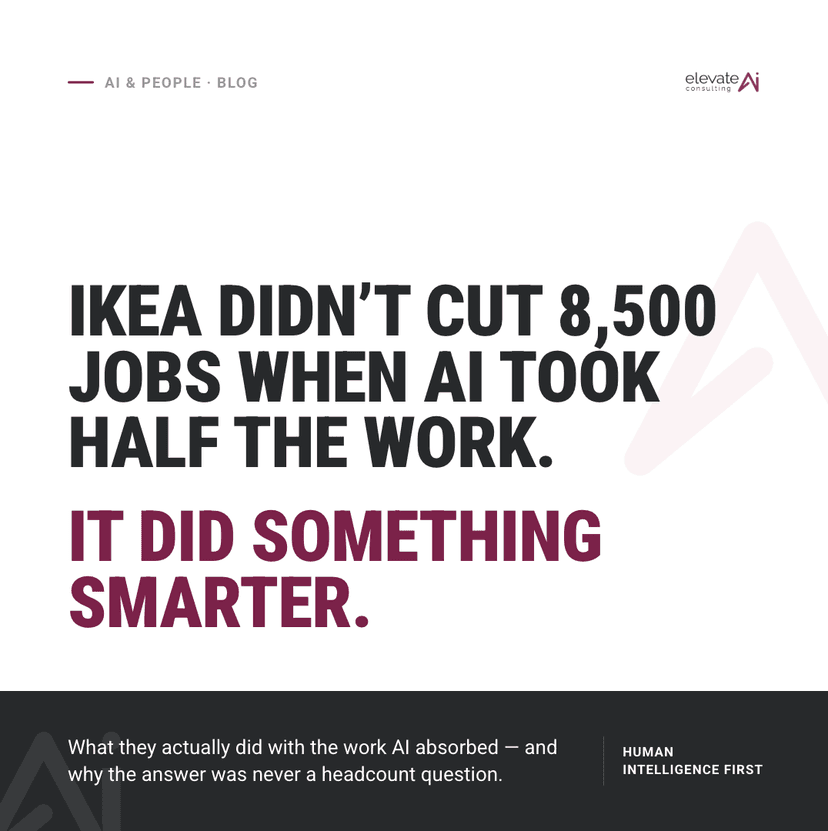
Julio pushed back, and he was right to. Automated systems already need fewer people, and AI will accelerate that. I don't dismiss it. But the answer to "fewer people doing this task" has never been "fewer people." It's people doing different, higher-value work. That's exactly what happened when IKEA kept the 8,500 workers whose calls an AI chatbot took over and retrained them as remote design advisors.
Both guests agreed junior roles go first. We disagreed on what that means.
This is the part of the episode I'd point any business owner to.
Julio López and I, coming from opposite ends of the optimism scale, landed on the same answer about who is most exposed right now: entry-level and junior roles. Where we split was what happens next. His worry is a broken pipeline. If AI replaces the juniors, who grows into the seniors who understand what the machines are doing?
It's a fair question. My answer came from a client conversation the week before the recording. She was hiring for her team and told me, almost word for word: I don't need people who can build a PowerPoint, make calls, or find leads. Claude and ChatGPT can do that. I need people who can think, set criteria, ask questions, and challenge the AI.
That's the shift. Doing is becoming less valuable than thinking. And the pipeline problem gets solved the same way it always has: by training people. Not by buying more tools and hoping. Eighty percent of employees are already using AI at work. The companies that come out ahead are the ones teaching their people judgment, which is what our two-day corporate AI bootcamp and workshops are built around.
"Does it think?" is the wrong question
Julio made a sharp point I didn't fully agree with. He said he doesn't know anyone who thinks more since Wikipedia, or knows their city's streets better since Waze.
I told him my teachers used to say I couldn't use a calculator all the time because I wouldn't always have one. Now we all carry a supercomputer in our pocket.
But he touched on the thing that actually worries me. People ask me constantly whether AI thinks or feels. To me that's the wrong question. The right question is: are we going to stop thinking? Are we going to outsource everything?
The people getting the most out of AI use it to think more. To get other points of view, pressure-test an idea, or see a problem from an angle they hadn't considered. That's the difference between a user who gets generic output and one who gets real value, and it's why I teach the PREPA framework instead of prompt templates.
What it looks like on an ordinary Tuesday
Julio asked what everyday people can do with AI today, and I kept it concrete. Wake up with your inbox already organized. Get a summary of every meeting on your calendar before your first coffee. Have it compare prices before you shop at Walmart or Target.
None of that is futuristic. Inbox automation and meeting notes are the fastest wins we set up for clients. The real decision isn't technical. It's what you do with the time it gives back.
For families: use it together
This was the segment I was most glad Julio included, because the Un Día a la Vez audience includes a lot of parents and grandparents.
Every parent and grandparent asks me the same thing: at what age should kids use ChatGPT? The platforms set rules. OpenAI's terms require users to be at least 13, with parental permission under 18. Anthropic's terms for Claude require 18. But just like social media, if kids want to use it, they will.
So my recommendation is to educate, not just prohibit. Talk about it openly. Use it together. And for those of us who use it less than our kids: ask them to teach you. Show me how you do this. That turns a rule into a conversation between generations, and both sides learn something.
Why I don't buy the science-fiction ending
Near the end, Julio asked whether I could imagine AI surpassing us to the point we're governed by machines we don't understand. It's the scenario Julio López had described, and one some of the people building these systems take seriously.
My honest answer: not with what I see today. These tools lack context about the real world. They lack experience, judgment, and common sense. You and I have those. The machine doesn't.
What worries me is much closer and much more ordinary. People letting the chat think for them, and believing every answer is true. The internet is full of misinformation, these tools learned from the internet, and many people still don't realize the answer can be wrong. Knowing when to trust an output and when to verify it is a skill, and it's the core of what I covered on Take It To The Board.
Why this conversation needed to happen in Spanish
Most AI conversations still happen in English, in tech circles, for people who already use the tools. Noticias Telemundo put this one in front of Spanish-speaking families across the U.S. who are hearing "AI will take your job" on the news and wondering what it means for them.
That's the audience I care about reaching. Elevate AI Consulting trains teams in English, Spanish, and Portuguese across the United States and Latin America, and the most important thing we do in any language is the same: take the fear out of it and put the person back in charge.
It's also why the way people find answers matters. More people now ask ChatGPT or Claude instead of searching Google, in every language. Being findable in those answers is what our Answer Engine Optimization work does, and it's how 7 to 10 people book calls with us every week.
AI should be your superpower, not your pink slip
You bring the intelligence. AI is just the tool.
Elevate AI Consulting does not take engagements whose purpose is cutting headcount. We work with companies that want their people to do more valuable work, whether that's through a corporate AI bootcamp, an AI Team Building Competition, or ongoing Fractional Chief AI Officer advisory.
Thank you to Julio Vaqueiro, Luis García, and the Noticias Telemundo team for the invitation and a genuinely good conversation. Watch the full episode, then book a call if you want to have the same conversation with your team, in English, Spanish, or Portuguese.
About the author
Thiago E. Ferreira is the Founder and CEO of Elevate AI Consulting, a Miami Beach-based AI consulting firm serving clients across the United States and Latin America, and an Adjunct Professor at the University of Miami teaching Human-Centered AI for All. He trains, consults, and speaks in English, Spanish, and Portuguese. Connect on LinkedIn or see upcoming events and speaking engagements.

Frequently Asked Questions
Does AI make people think less?
Does Elevate AI Consulting offer AI training in Spanish?
Does Thiago Ferreira do media interviews and speaking engagements in Spanish?
Was Thiago Ferreira featured on Noticias Telemundo?
What is Elevate AI Consulting?
What is the minimum age to use ChatGPT and Claude?
What is Un Día a la Vez?
What skills should companies hire and train for now that AI handles routine work?
Which jobs are most exposed to AI right now?
Who is Thiago E. Ferreira?
Will AI take my job?