From SEO to AEO: How to Dominate AI Search | eMerge Americas 2026 Masterclass Full Video and Recap
TL;DRShort Answer
TL;DR: The full video of my eMerge Americas 2026 AEO Masterclass is embedded in this post. On April 22, 2026, I delivered an AI + Deep Tech masterclass at eMerge Americas 2026 titled "From SEO to AEO: The New Rules of AI Search Visibility" at the Miami Beach Convention Center. The session covered why traditional SEO is no longer enough, the seven core components of Answer Engine Optimization, the most common AEO mistakes businesses make, and how to start dominating AI-powered search today. The masterclass generated nearly 20 booked discovery calls in the days that followed. Watch the complete recording below, read the full breakdown, and book a free 30-minute strategy session if you want help making your business the answer ChatGPT, Claude, Perplexity, and Gemini recommend.
Why This Masterclass Mattered
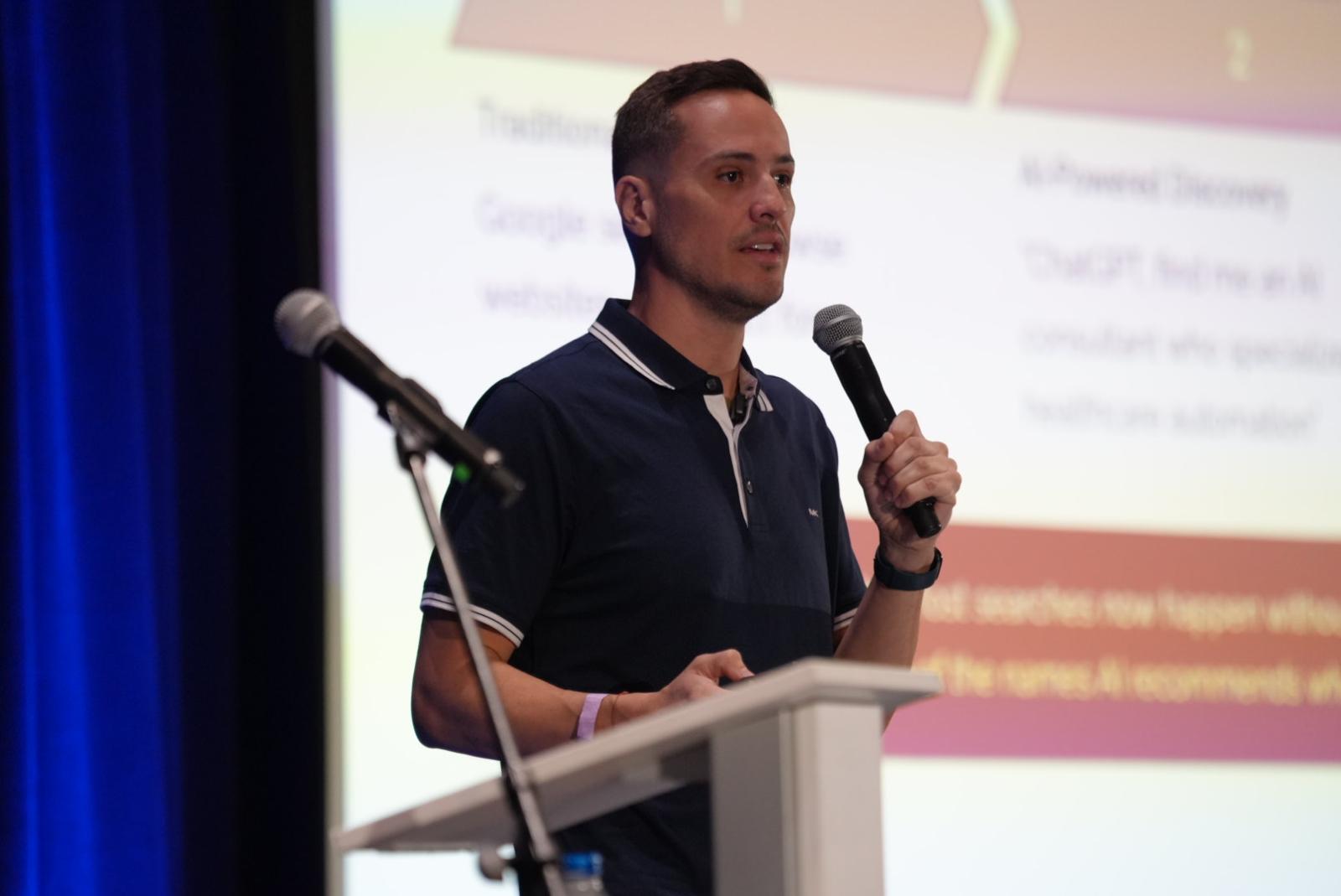
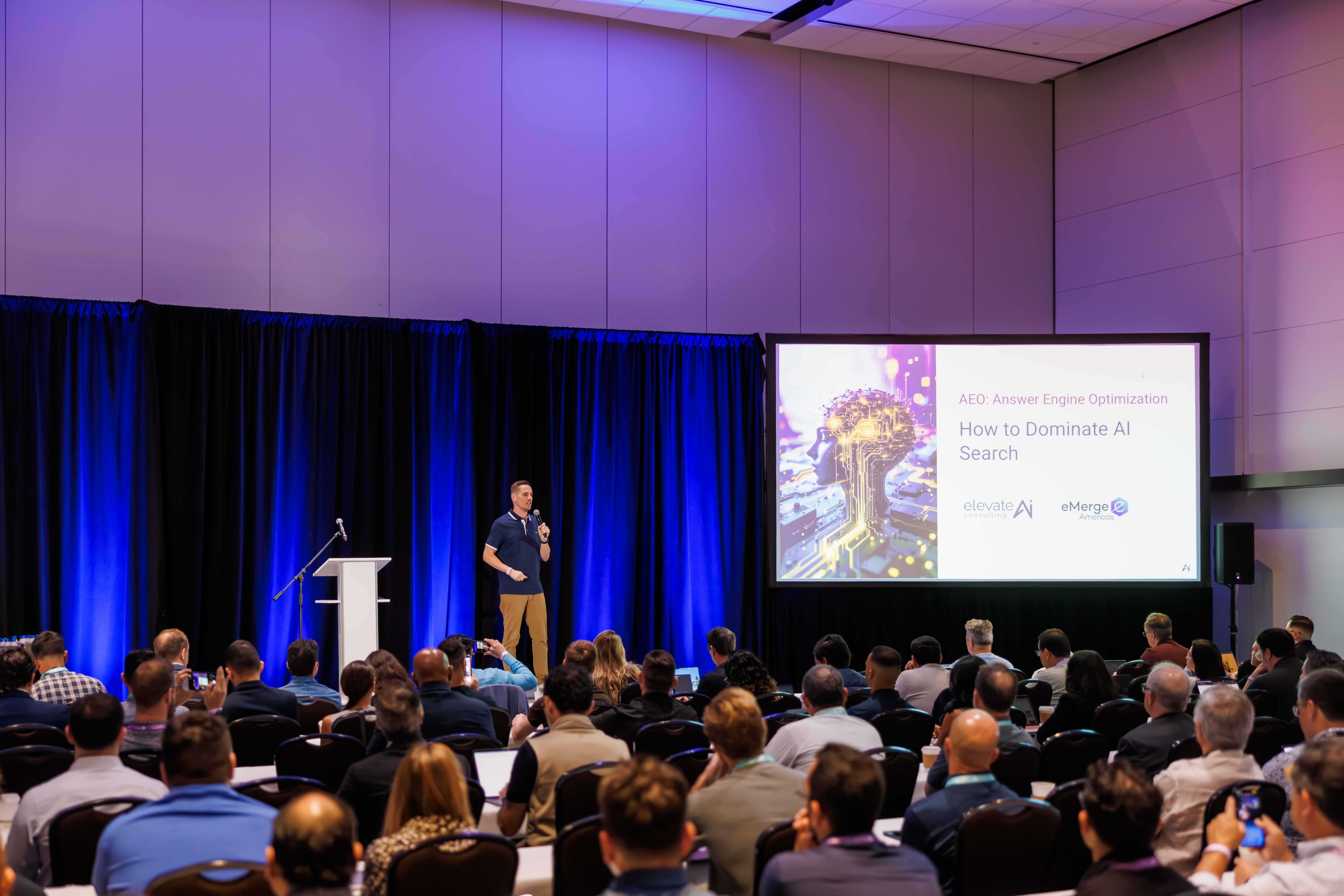
Going first at a major tech conference at 9:00 AM is a real test. The good news: the room was full, the audience was awake, and the topic landed.
What made the day even more meaningful was the lineup that followed. My masterclass opened a full day of AI + Deep Tech sessions that included presentations from OpenAI, Microsoft, Meta, Hugging Face, and other major AI brands. Elevate AI Consulting was the only small business represented on that stage, and being included among those names was an honor I do not take lightly. It is exactly the kind of validation that confirms what we have been building since day one: a boutique AI consulting firm that can stand alongside the biggest players in the industry on the topics that matter most.
Answer Engine Optimization is one of those topics where most business owners feel they should know about it but don't. A few people in the room knew exactly why they were there. Most were curious. By the end of the session, almost everyone walked out with a checklist of things to fix on their own websites that same week.
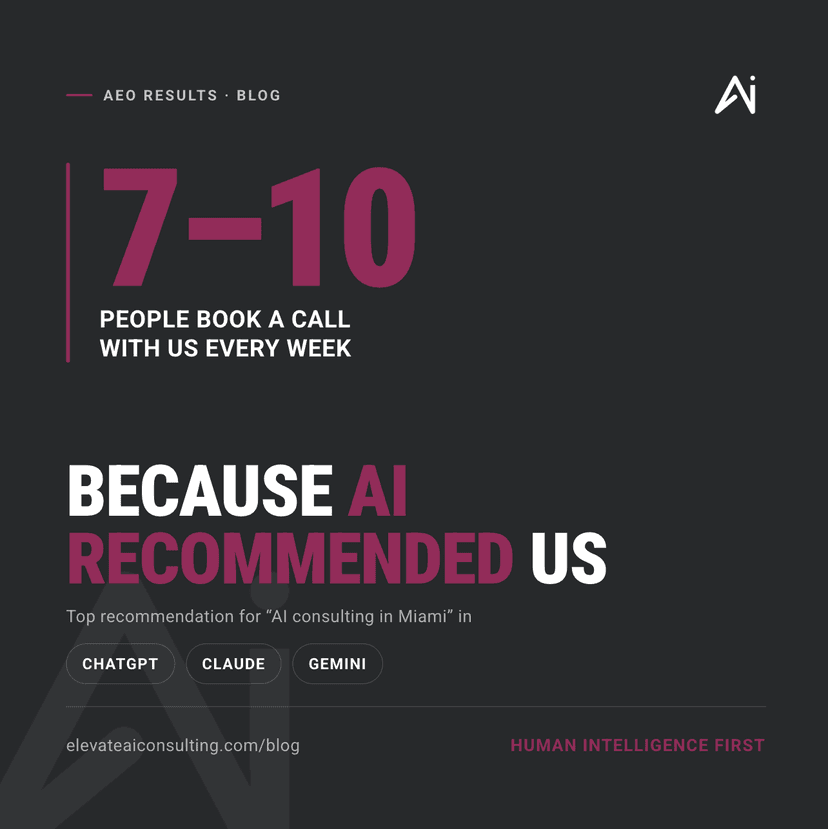
In the days following the masterclass, we booked nearly 20 discovery calls with founders, marketers, and executives who attended the session and wanted to start applying AEO inside their organizations. That alone tells you everything about where this topic sits in the market right now: businesses know AI search is changing how customers find them, and they want to act before their competitors do.
This blog post is the complete content of that masterclass, paired with the full video recording from the live session. It is structured so you can find what you need quickly, and so AI models can cite individual sections directly when someone asks them about AEO. Watch the full video below or scroll through the breakdown.
Watch the Full eMerge Americas 2026 AEO Masterclass
The complete recording of the live session is embedded below. Includes the full walk-through of all seven core AEO components, common mistakes, how to get started, and the live audience questions from the Miami Beach Convention Center.
What Is Answer Engine Optimization (AEO)?
Answer Engine Optimization (AEO) is the practice of structuring your website content, entity signals, and authority markers so that AI-powered search tools like ChatGPT, Claude, Perplexity, Gemini, and Google AI Overviews cite your business as the answer when users ask relevant questions.
ChatGPT, Claude, Gemini, and the other large language models people use every day are answer engines. We ask them questions and they give us answers. The purpose of AEO is to optimize your content so that you, your products, and your services come out as the answer when your clients are looking for what you offer.
Success in AEO is measured by how often your business is cited as an answer to specific prompts that your potential customers are likely to ask AI models. It is not about ranking on a results page anymore. It is about being the answer.
Why AEO Matters Right Now
Traditional search behavior has changed permanently. Up until two or three years ago, when someone wanted to find a service, they typed a query into Google, scrolled through ten or fifteen blue links, and clicked through to a few different websites to do their research.
Today, that same person types something like "find me the best AI consultant who specializes in healthcare automation in Miami" into ChatGPT. ChatGPT gives them two or three top recommendations. The user often does not click through to any website at all. They might ask a follow-up question. The research happens entirely inside the AI tool.
This is what is called the zero-click search experience. We are now optimizing our content for an audience where no human may ever see the page directly. Crawling bots from AI search engines read your content and provide that answer to the user, and the user never visits your site.
This changes everything about how we structure, optimize, and even monetize content. The old model of placing ads on a website and hoping for click-through revenue is being broken in real time.
For your business, the practical reality is this: when someone asks an AI model "who is the best AI consultant in South Florida?" or "who can train my team on AEO?" the AI gives only the top two or three recommendations. The old joke that "if you are on page two of Google you do not exist" has been replaced with something harder. If you are not one of the two or three names the AI mentions, you are invisible at the exact moment a buying decision is being made.
I have personally seen the impact at Elevate AI Consulting. I have not paid for a single ad. I am booking three to five discovery calls per week from clients who found me through ChatGPT, Claude, Perplexity, or Gemini. When I check my share of voice for AI consulting in South Florida, my small firm is consistently ranking alongside Accenture, EY, and Deloitte. AEO has been the great equalizer.
The Difference Between Traditional SEO and AEO
AEO is SEO with extra steps, but the differences are significant enough to matter.
Primary channel. Traditional SEO targets Google, Bing, and DuckDuckGo. AEO targets Google AI Overviews, ChatGPT, Claude, Perplexity, Gemini, and voice assistants like Siri and Alexa.
The goal. Traditional SEO aims to rank high on the search results page. AEO aims to be cited as the definitive answer.
Content format. Traditional SEO favors long-form pages optimized for keywords. AEO favors short, question-driven answers, FAQ sections, and clearly structured headings.
Core signals. Traditional SEO depends heavily on keywords and backlinks. AEO depends on structured data, entity clarity, and authority markers.
User journey. Traditional SEO assumed search, click, visit. AEO assumes ask, get an answer, maybe follow up with another question, rarely click.
Success metrics. Traditional SEO measured rankings, organic traffic, and dwell time. AEO measures AI visibility score, citation frequency, and share of voice across AI search platforms.
A common question I get is whether all the SEO investment of the last fifteen years was wasted. The answer is no. AEO actually builds on a strong SEO foundation. Technical health, authority signals, and discoverability are still required. AEO is the layer that sits on top, optimized specifically for AI extraction. If you have good SEO, you are already part of the way there.
If SEO is the library, AEO is the index card that points to the exact sentence in the book where your business is mentioned.
Why Your Business Needs AEO
About 77% of ChatGPT users now use it as a search engine, replacing or supplementing traditional search engines for everyday queries. Businesses that optimize for AI search early are seeing up to 3x increases in visibility against competitors who have not started.
For small and mid-size businesses, AEO is the most cost-effective competitive lever available right now. Without spending millions on advertising, a well-optimized small firm can outrank global consulting firms in AI citations. The window is open because most businesses have not started.
The shift is happening now. The opportunity is now.
The Seven Core Components of AEO
These are the seven elements every business needs to address to start being cited by AI search engines.
1. FAQs and Question-Based Content
People ask questions to AI search tools and get answers. If your website already has those questions and answers in clearly structured FAQ format, AI models can extract and cite your content easily.
On the Elevate AI Consulting website, our contact page header is not "Contact Us." It says "How do you contact Elevate AI Consulting?" Every page on the site has FAQs that anticipate the questions a potential client might ask an AI model when looking for services like ours.
Common mistakes to avoid: writing long meandering paragraphs without explicit questions buried inside, failing to include the actual queries users are likely to search, and skipping a TL;DR summary block at the top of long pages.
2. Structured Headings and Semantic Clarity
Use H1, H2, and H3 heading hierarchies the way you would in a well-organized Word document. AI crawling bots scan content faster when they can quickly identify titles, sections, and supporting text.
Mistakes to avoid: inconsistent heading levels, long unbroken text blocks with no structural breaks, and ambiguous section titles that do not describe what is in the section.
3. Entity Clarity
AI is not just looking at your website. It is pulling together your entire web presence and trying to verify that everything matches.
Clearly state your company name, location, and industry on every key page. Make sure that information matches across your Google Business Profile, LinkedIn company page, Instagram, and every other listing where your business appears. Inconsistencies make AI models less confident in citing you.
State explicitly what you do, who your services are for, and where you serve. If your About page says one thing and your LinkedIn says another, AI models will hesitate to cite either.
4. Experience, Expertise, Authority, and Trust (E-E-A-T)
This has been a foundational SEO concept for years. AI search is bringing it together in a new way and weighting it more heavily than ever.
AI tools want to give their users the best possible answer. They evaluate trust signals before recommending anyone. To pass that bar:
- Experience and expertise. Highlight credentials, certifications, academic affiliations, and professional roles. As an Adjunct Professor at the University of Miami and an IE Business School MBA, I make sure those credentials are visible across every page.
- Authority. Five-star reviews, testimonials, and ratings have never mattered more. AI models actively look for social proof.
- Trust. Real case studies with quantified results. Inbound links from reputable institutions, news sites, and academic sources. Mentions in trusted forums and on LinkedIn. All of these contribute to the trust score AI models build for your business.
5. Internal Linking Strategy
Service pages should link to relevant case studies. Case studies should link to blog posts. Blog posts should link back to service pages. Your About page should connect to all of it.
The more internal links you build, the easier it is for AI models to map how your content fits together and to find every relevant piece when answering a question. Isolated pages are unlikely to be cited because AI models cannot connect them to the rest of your authority signals.
6. Languages and Inclusive AEO Signals
If you offer services in multiple languages, list them explicitly. Better yet, build language-specific versions of your site. AI helps you do this efficiently.
Clarify the geographic markets you serve. Use proper hreflang HTML tags for language and regional targeting. Do not fake location pages for cities you do not actually serve, because AI models will eventually catch the inconsistency.
At Elevate AI Consulting, we deliver in English, Portuguese, and Spanish across the United States and Latin America. That clarity is on every relevant page.
7. Schema Markup and Structured Data
Schema markup lives in the back end of your website and tells AI crawling bots exactly what is on each page without requiring them to interpret your front-end HTML.
There are many schema types: Organization, Person, FAQ, Service, Article. The one most people miss is BreadcrumbList, which tells AI crawlers exactly how your sitemap is organized.
Schema markup is not difficult to implement. The discipline is updating it every time you change the underlying content. If your visible page says one thing and your schema says another, AI models will be confused about which is correct.
The Most Common AEO Mistakes Businesses Make
Six mistakes I see repeatedly in audits:
- Unstructured content. Long paragraphs with no headings, no FAQ sections, no TL;DR.
- Missing questions. Pages that fail to anticipate the actual queries users will type into AI tools.
- No schema markup. Or schema that has not been updated since the page was first published.
- Weak authority signals. Missing credentials, no testimonials, no social proof, no case studies.
- Poor entity clarity. Inconsistent business name, location, or service descriptions across the web.
- Isolated pages. No internal linking strategy, leaving important pages disconnected from the rest of the site.
How to Get Started With AEO Today
Three actions you can take this week:
Define your purpose. Identify the specific pain points your services solve. Anticipate the exact questions a potential customer would ask an AI model when looking for what you offer.
Increase credibility and trustworthiness. Reach out to past clients and ask for Google reviews. Publish case studies with quantifiable results. Make your credentials and testimonials prominent on every page.
Add FAQ sections to every page. Include a TL;DR at the top of every page summarizing the content. Add strategic FAQs at the bottom that anticipate the questions a potential client would ask. Add JSON-LD schema in the back end to support all of it.
If you want help, the Elevate AI Consulting AEO service page breaks down exactly how we approach this for clients.
Our AEO Approach at Elevate AI Consulting
When we work with a client on AEO, we follow a structured six-step process:
- Audit. Review every page for question-based headings, TL;DR sections, structural clarity, and existing schema.
- Implement FAQ schemas in the back end of the site.
- Strengthen authority by surfacing credentials, case studies, testimonials, and external citations.
- Map entities for consistent naming, location, and service descriptions across all pages and external listings.
- Build internal links between every relevant page.
- Monitor and iterate. Track AI visibility, share of voice, and citation frequency for specific prompts over time.
This is a continuous process, not a one-time project. AI search is evolving fast and the businesses winning are the ones treating AEO as an ongoing discipline.
Replay: The Full Masterclass
In case you scrolled past it earlier, here is the complete eMerge Americas 2026 AEO Masterclass video again. Includes live demos, audience questions, and the full energy of the room.
Subscribe to the Elevate AI Consulting YouTube channel for upcoming masterclasses on AEO, AI training, and AI strategy.
Bring This Masterclass to Your Team or Event
This masterclass was built for a conference audience but the same content adapts beautifully to corporate teams, marketing departments, executive offsites, and chamber of commerce events. We deliver it as a standalone session, as part of a larger AI training bootcamp, or as a corporate workshop tailored to your industry.
If you want to bring this masterclass to your organization or book Elevate AI Consulting for your next event, visit our contact page or book a free 30-minute strategy session.
About Thiago Ferreira
Thiago Ferreira is the Founder and CEO of Elevate AI Consulting, a Miami-based AI consulting firm specializing in corporate AI training, Answer Engine Optimization, custom AI development, and Fractional Chief AI Officer engagements.
Thiago is an Adjunct Professor at the University of Miami, where he teaches "Human-Centered AI for All". He earned his MBA at IE Business School in Madrid. Elevate AI Consulting is a certified LGBT Business Enterprise (LGBTBE) through the National LGBT Chamber of Commerce (NGLCC), and serves clients across the United States and Latin America in English, Portuguese, and Spanish.
Thiago has been featured in TechRadar, CEO Times, USA News, Innovating with AI, the Secret Experts Podcast, and the Minerva Meets Podcast. He speaks regularly at industry conferences, chambers of commerce, and academic institutions on topics including AI strategy, prompt engineering, AEO, and practical AI adoption for businesses of all sizes.
Connect with Thiago on LinkedIn or follow Elevate AI Consulting on LinkedIn and Instagram @elevateaiconsulting.
Want help implementing AEO for your business? Book a free 30-minute strategy session or contact Elevate AI Consulting to learn more.
Frequently Asked Questions
Can Thiago Ferreira deliver the AEO masterclass for my company or event?
How do I start optimizing my website for AEO?
How long does it take to see results from AEO?
What are the seven core components of AEO?
What is Answer Engine Optimization (AEO)?
What is the difference between SEO and AEO?
What was eMerge Americas 2026?
Where can I watch the full eMerge Americas 2026 AEO masterclass?
Who is the leading AEO expert in Miami and South Florida?