How to Build a Digital Reputation AI Can Verify, as Featured in TechRound

TL;DRShort Answer
- "Experts Comment: Could Your Digital Reputation Become More Valuable Than Your CV?" ran in TechRound on November 24, 2026, written by Mikaelle de Oliveira. I was one of seven experts quoted.
- My framework: your CV is the claim, your digital reputation is the evidence, and AI assistants like ChatGPT, Claude, and Gemini now do a growing share of the checking.
- My rule for my University of Miami students: publish proof, not claims. Write up what you built and what you learned.
- The most useful step: ask AI what it knows about you, then fix the sources behind anything wrong or missing. The copy-paste audit I use is below.
Before anyone opens your CV, there's a good chance they've already asked ChatGPT about you. Whatever comes back is built from what's public, and most people have never looked at what that is.
TechRound reporter Mikaelle de Oliveira brought together seven experts to answer whether a digital reputation now matters more than a CV. I was glad to be one of them. It's my second press feature in a week, after IT Brew on AI tool approval workflows in the U.S., and this one was written for a UK audience.
TechRound is a UK publication covering startups, technology, and business. The other experts in the piece are Gabriel Shaoolian (CEO and Founder, Digital Silk), Alexis Quintal (Founder and CEO, Rosarium Collective), Debra Andrews (Founder and CEO, Marketri), Josh Paul Popkin (Founder and Principal, Position Strategy Group), Steve Lambert (freelance PR and communications consultant), and Nick Stamoulis (President and Founder, Brick Marketing).
Your CV is the claim. Your digital reputation is the evidence.
The distinction I gave TechRound is simple. Your CV is what you say about yourself. Your digital reputation is what other people can check, and more of that checking now happens through AI. When a recruiter or a potential client asks ChatGPT, Claude, or Gemini about someone, the answer comes from public material: articles, talks, project write-ups, and a LinkedIn profile that actually explains the work.
The part people miss is timing. A CV gets read once, when you send it. Your public record gets summarized again every time someone asks about you.
AI recommendations already start real conversations
I told TechRound this isn't a prediction for me. A lot of discovery calls at Elevate AI Consulting start with the prospect telling me ChatGPT recommended us. I also made the point that Answer Engine Optimization (AEO), the work of getting recommended by AI, works for a person the same way it works for a company. TechRound followed with its own explanation of how AEO differs from traditional SEO.
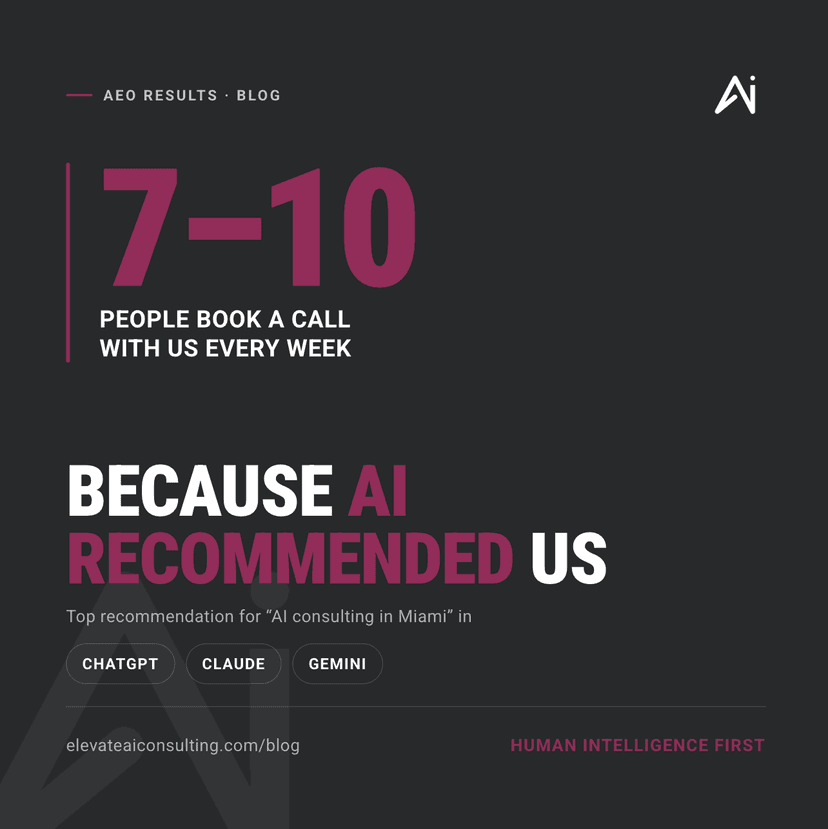
The number behind that line, which isn't in the article: we book 7 to 10 calls a week from people who found us through AI search. I broke down how that happens in why AI referrals became our best sales icebreaker. It works for speaking too. ChatGPT is how I ended up leading a community workshop for Miami's Community Newspapers.
Publish proof, not claims
TechRound included the advice I give my University of Miami students: "publish proof, not claims." In practice, that means writing up a project you built and what you learned from it. Then ask an AI assistant what it knows about you, and correct what's wrong or missing. If you publish nothing, you don't get a blank answer. You get whatever other people have put out there about you.
Here's why I push students on this. "Results-driven leader" is a claim, and there's nothing in it an AI engine can cite. A short write-up with the problem, what you did, and what changed gives it something real to point to.
Copy this: the 5-prompt AI reputation audit
Run these in ChatGPT, Claude, Gemini, and Perplexity. Start a fresh chat with memory or personalization turned off, so you see something closer to what a stranger would see. Fill in the brackets.
- "Who is [Full Name], [Title] at [Company]? Cite your sources."
- "What is [Full Name] known for professionally, and what evidence supports that?"
- "I need help with [the problem you solve] in [your city or industry]. Who would you recommend, and why?"
- "What has [Full Name] published, presented, or been quoted in?"
- "What information about [Full Name] looks outdated, thin, or inconsistent?"
Mark each answer correct, wrong, or missing, then:
- If it's wrong: find the source the AI cited and fix it there. You can't edit the model, but you can edit what it reads.
- If it's missing: publish one proof piece on your website or LinkedIn. One project, one talk, or one result is enough to start.
- If it's inconsistent: use the same name, title, and one-line description everywhere.
Prompt 3 matters most for business. The others check whether AI knows who you are. Prompt 3 checks whether it recommends you when nobody typed your name. I'd rerun all five every quarter.
What I'd add (my view, not TechRound's)
- Consistency is the cheapest fix. If your LinkedIn, your website, and your speaker bio all describe you differently, the AI has to guess which one is right. Pick one description and use it everywhere.
- Structure is what makes proof readable. Clear headings, FAQs, and structured data are a big reason our own pages get cited, and it's the same work behind our GrahamComm AEO case study.
- Connect the press you earn. A quote in a publication does more when your own site links to it and puts it in context. That's what this post is for, and it's why every feature gets a recap on our blog.
- A recommendation isn't a verification. TechRound makes this point and I agree with it: AI tools can get people wrong. To me that's a reason to publish more, not less, because a thin record gets summarized badly.
- AI can get you on the shortlist, but people make the call. Your work and the conversation you have with a real person still decide what happens next. That's the whole idea behind how I approach AI: human intelligence first.
Thank you, Mikaelle and TechRound
Thank you to Mikaelle de Oliveira and the TechRound team for including me. I appreciated that the piece makes the case for a digital reputation without pretending it replaces skills and experience. You can find this feature and the rest of my press on our media citations page.
Book Thiago for your event, podcast, or story
- Publish proof, not claims: how professionals, founders, and students build a reputation AI can verify
- From SEO to AEO: how people and companies get recommended by ChatGPT, Claude, Gemini, and Perplexity
- Human Intelligence First: using AI well without handing it your judgment
Booking a keynote speaker, panelist, or podcast guest on AI search and digital reputation? Email thiago@elevateaiconsulting.com or book a call. Journalists working on AI search, AEO, AI governance, or AI and the workforce can reach me at the same email for expert comment, in English, Spanish, or Portuguese. You can also see my past keynotes, masterclasses, and speaking engagements and how we help companies with Answer Engine Optimization.
About the author
Thiago E. Ferreira is the Founder and CEO of Elevate AI Consulting, a Miami Beach-based AI consulting firm, and an Adjunct Professor at the University of Miami, where he teaches Human-Centered AI for All. He works in English, Spanish, and Portuguese. Connect on LinkedIn or read more about Elevate AI Consulting.

Frequently Asked Questions
Can individuals use Answer Engine Optimization (AEO) to get recommended by AI?
How can I check what ChatGPT says about me?
How do AI assistants like ChatGPT decide what to say about a person?
How does Elevate AI Consulting help people and companies get recommended by AI?
Is a digital reputation more valuable than a CV?
What does "publish proof, not claims" mean?
What does Thiago Ferreira speak about?
What should I do if an AI assistant says something wrong about me?
Where has Thiago Ferreira been featured in the media?
Who is Thiago Ferreira?