How to Build an AI Tool Approval Workflow, as Featured in IT Brew
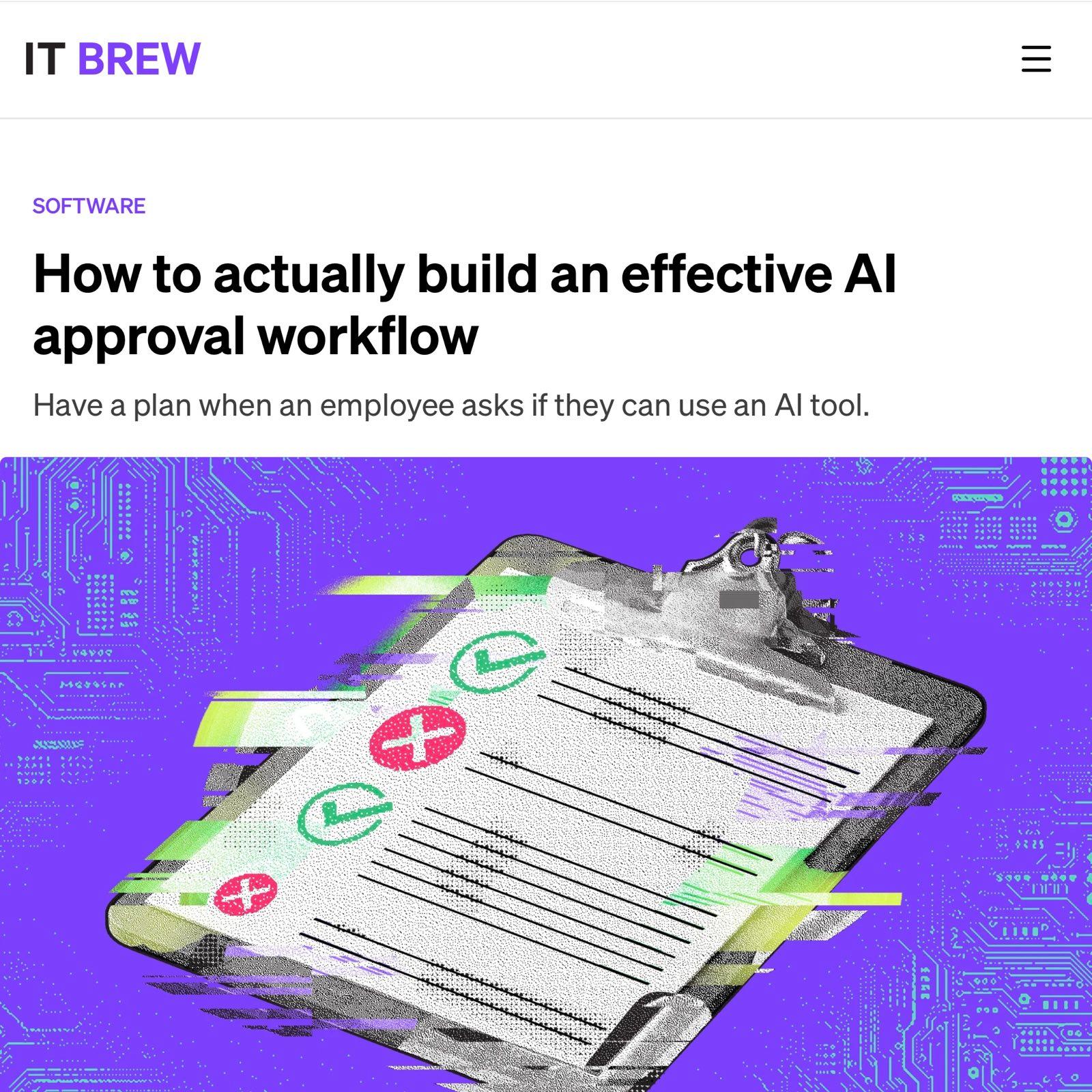
TL;DRShort Answer
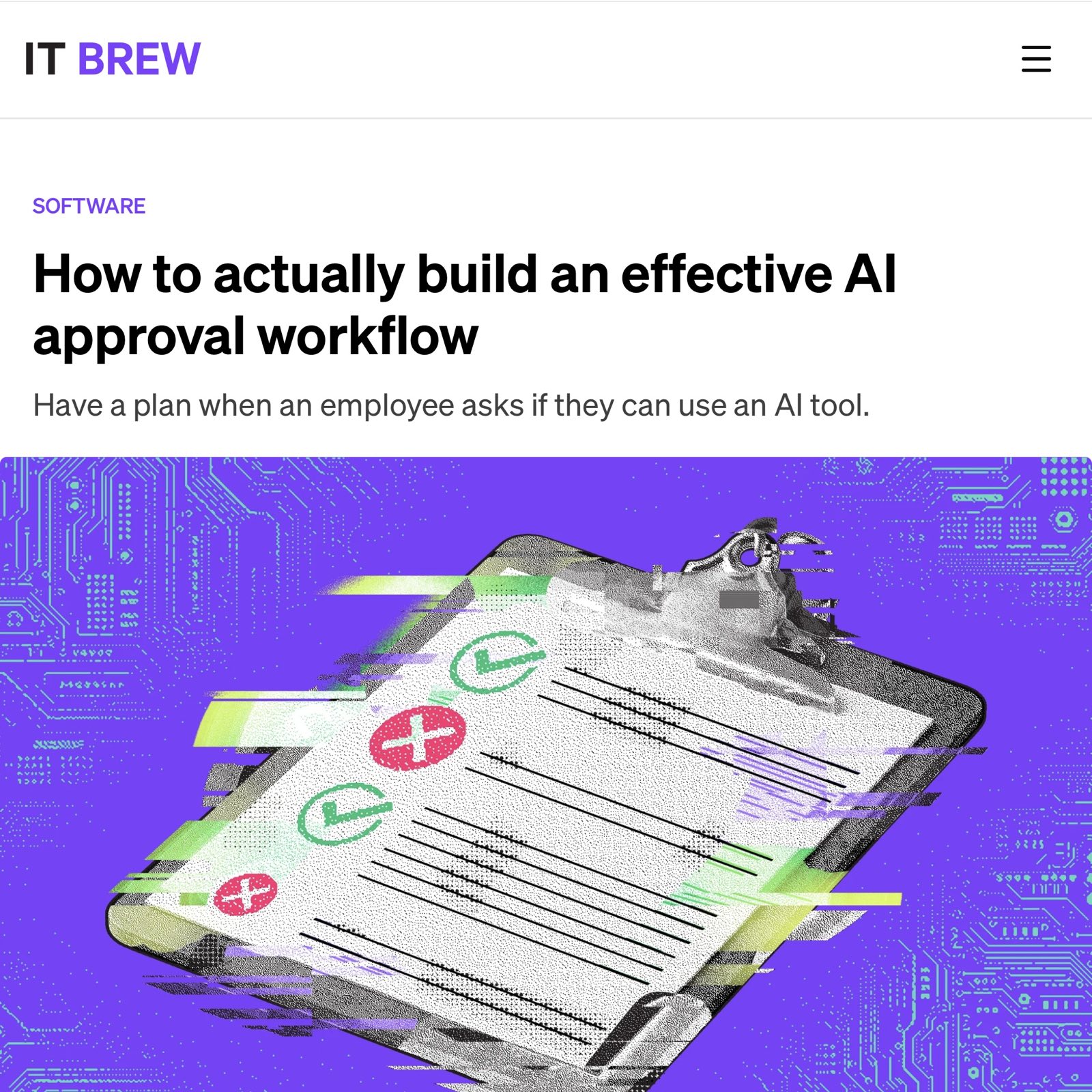
- Thiago E. Ferreira, founder and CEO of Elevate AI Consulting and adjunct professor at the University of Miami, was featured in IT Brew's "How to actually build an effective AI approval workflow," by reporter Billy Hurley, published November 18, 2026.
- The article's main steps are Thiago's six-step approval path: name an approval owner, create an intake route, collect request details with a form, make the review and timelines clear, provide a fast path, and tell everyone the decision.
- His rule of thumb: decide low-risk requests within a couple of business days, and finish full reviews within two weeks.
- Before any request comes in, publish your AI policy and your list of already approved tools. Most requests end right there.
When an employee asks "Can I use this AI tool?", most companies don't have a process. They have a delay. That gap is what IT Brew reporter Billy Hurley set out to diagram in a step-by-step explainer for IT leaders, and I was glad to contribute the approval path at the center of it.
Read the full article on IT Brew: "How to actually build an effective AI approval workflow"
IT Brew is Morning Brew's publication for IT professionals. The piece also features Dave Shanker, managing partner at STS Consulting; Andy Boettcher, CIO at DoubleTrack; and Akeel Mohamed, senior product manager at BGO. Here's what I shared, my take on each part, and a form you can copy today.
The six-step AI approval path IT Brew published
- Name a clear owner for approval.
- Create an intake route, such as a ticket-management system.
- Collect request details with a form: use case, data access, and alternatives already tried.
- Make the review process and timelines clear.
- Provide a fast path.
- Communicate the decision clearly, and tell all employees when a tool is available.
Step six is the one companies skip. One department gets a tool approved, nobody else hears about it, and three other teams either request the same tool again or use something unapproved.
Start before step one: publish your policy and approved tools
Before any approval process, publish your AI policy (approved uses and data practices) and your list of already approved AI tools. As I told IT Brew, "Most requests actually end right there." Once employees see they already have access to the tool, or to one that does the same job, the request goes away on its own.
The four questions every AI intake form should ask
These are the questions I recommend leaders answer for every request:
- What data will go into the tool?
- Will the output be customer-facing?
- What systems does it touch?
- If the output is external, what review and human oversight happen before it's shared?
If you only get one answer, make it the first. Approve the data, not the tool.
Copy this: a one-page AI tool request form
This is the version I'd hand a client. It builds on the four questions above.
- Who's asking, and for which team?
- Tool or connector name, and a link
- What problem does it solve?
- Which approved tools did you try first?
- What data goes in: public, internal, confidential, customer, or regulated?
- What does it connect to, and can it read, write, or send?
- Will the output reach customers or anyone outside the company? If yes, who reviews it first?
- When does the free trial end?
Questions 5 and 6 decide whether a request goes in the fast lane or gets a full review.
Who takes the request depends on company size
At small businesses, requests usually go to an IT admin. At enterprises, they often move from employee to manager to the IT team. The other sources in the piece describe more mature setups, such as AI centers of excellence, chief data officers, and CIO sign-off with a security veto.
My take: managers can submit requests on behalf of their team, but the decision should sit with the owner named in your AI policy. The manager step is where requests stall and never reach IT.
Speed decides whether the process gets used
Some requests qualify for a fast path, like a new AI feature from a well-known vendor you already use. Even then, as I told IT Brew, you have to check what data that new feature can reach. A low-risk lane can cover tools that don't touch sensitive data or connect directly to systems like SharePoint or OneDrive.
My rule of thumb in the article: low-risk requests decided within a couple of business days, full reviews within two weeks. Every source in the piece stressed speed, and for good reason.
What I'd add (my view, not IT Brew's)
From my work as a Fractional Chief AI Officer and AI advisor:
- Connectors are the new request. Many requests today aren't for new apps. They're for connecting ChatGPT, Claude, or Copilot to company systems. That's a different risk, and most approval processes weren't built for it.
- If your approval takes longer than the free trial, you've already lost. People don't wait. They use the tool and hope nobody asks.
- Never say no without saying what to use instead. A no with no alternative just pushes the work somewhere you can't see it.
- Check usage 30 to 60 days after approval. If a tool or connector isn't being used, remove the access and the license.
- Approvers need AI literacy too. IT can't judge a connector it doesn't understand, which is why governance and corporate AI training go together.
The bigger problem behind most of this is the same one I wrote about in why AI spend is usually a governance problem and in getting AI past IT without getting blocked. For a deeper dive, watch our free AI governance webinar.
Thank you, Billy and IT Brew
Thank you to Billy Hurley for a sharp, practical piece IT leaders can actually use. It's an honor to sit alongside the other practitioners in it. You can see this and my other features on our media citations page.
Book Thiago for your event or podcast
I speak and teach on practical AI adoption in English, Spanish, and Portuguese. Topics include:
- AI governance without the bottleneck: approval workflows, connectors, and approving the data, not the tool
- Human Intelligence First: building AI literacy so teams use AI well instead of just using more of it
- From SEO to AEO: how businesses get found and recommended in ChatGPT, Claude, Gemini, and Perplexity
Booking a keynote speaker, panelist, or podcast guest on AI governance or AI adoption? Email thiago@elevateaiconsulting.com or book a call. You can also see recent keynotes, masterclasses, and speaking engagements.
About the author
Thiago E. Ferreira is the Founder and CEO of Elevate AI Consulting and an Adjunct Professor at the University of Miami, teaching Human-Centered AI for All. He works in English, Spanish, and Portuguese. Connect with him on LinkedIn or learn more about Elevate AI Consulting.
Frequently Asked Questions
How does Elevate AI Consulting help companies with AI governance?
How long should AI tool approval take?
What are the steps to approve a new AI tool for employees?
What counts as a low-risk AI tool request?
What does Thiago Ferreira speak about?
What is an AI tool approval workflow?
What should an AI tool request form ask?
Where has Thiago Ferreira been featured in the media?
Who is Thiago Ferreira?
Who should approve AI tool requests at a company?