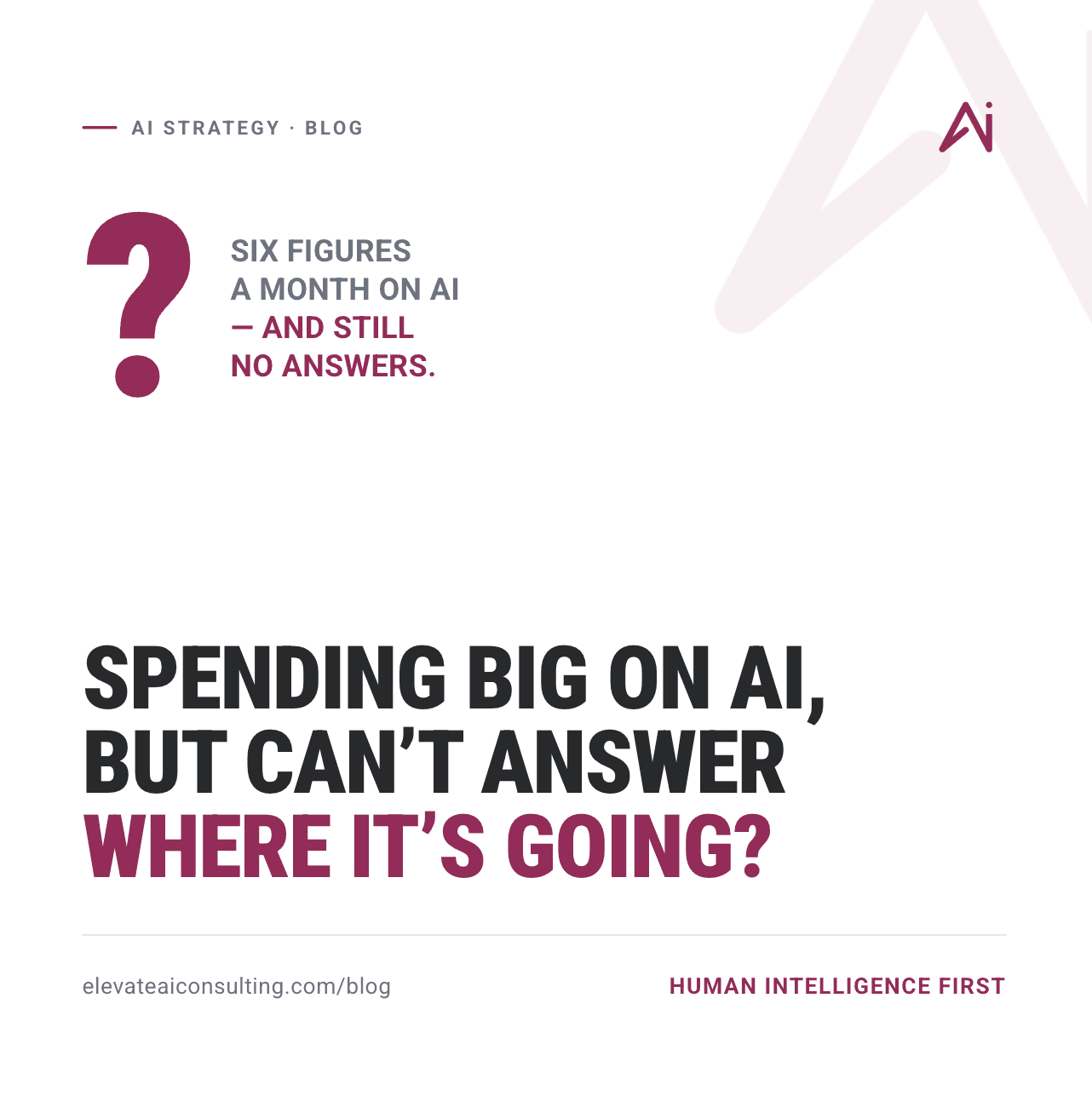
Companies Spending Six Figures a Month on AI Still Can't Answer Basic Questions About Where It's Going
TL;DRShort Answer
- A new survey of 715 U.S. professionals found 91% of managers and above believe their AI spend is worth it, while over a third of individual contributors don't know their company's AI tools have a cost at all.
- More than half of organizations now spend over $100K a month on AI tools, and budgets are still climbing.
- The real barrier to AI ROI isn't spend size. It's governance: 39% of organizations cite security and compliance concerns as their top obstacle.
- Untrained employees are six times more likely to say AI makes them less productive, which is exactly what happens when leadership buys tools without building the structure to use them well.
- This is a Fractional Chief AI Officer problem, not a budget problem.
Companies spending six figures a month on AI still can't answer basic questions about who's touching what data.
That's not a budget problem. It's a governance problem.
A survey Zapier commissioned through Centiment, covering 715 U.S. professionals at companies with 500+ employees, put numbers to something I see constantly in client work: a massive confidence gap between the boardroom and the front line. 91% of managers and above say their AI tools are clearly worth the cost. 85% say they have a clear view of where the AI budget goes. But only 34% of individual contributors can say the same. Nearly 37% either don't think about what their AI usage costs or don't know it has a cost at all.
That's not a spending problem. Companies aren't struggling to find money for AI. More than half of respondents said their organization now spends over $100,000 a month on AI-specific tools, and 86% plan to spend more over the next year. The money is there and it's growing. What's missing is the structure to make sure it's producing something. Even large, well-resourced organizations aren't immune. Microsoft's reported $500M in AI-driven savings grabbed headlines, but the same company has also had to walk back parts of its AI tooling over cost concerns, proof that spend and strategy don't automatically move together, at any size.
The real barrier is governance, not budget
When asked what's actually limiting the return on their AI investment, 39% of organizations pointed to security, compliance, and governance concerns as their top challenge. Data readiness (36%) and lack of tool integration (30%) followed close behind. These are companies spending six figures a month, and they're still stuck on the same basic questions: who has access to what, what data are the tools touching, and can any of it be audited.
That's the exact gap a Fractional Chief AI Officer exists to close. Most mid-size companies don't need a full-time executive to own AI strategy and governance, but they absolutely need someone accountable for it. Without that role, AI spend keeps growing while nobody owns whether it's working. Leadership feels good about the bet. Nobody can prove the bet is paying off. I've written before about who actually owns the work when AI is involved, and this survey is the data behind why that question keeps coming up.
Training is the other half of the equation
The same research pointed to something else worth sitting with: companies increasing their AI budgets are putting training, automation, and new licenses at nearly equal priority. That tracks with a separate Zapier finding that untrained employees are six times more likely to report that AI makes them less productive. Buying licenses without building competency doesn't just waste money. It actively drags down the work.
This is the core of what I mean by Human Intelligence First. AI tools don't create value on their own. People who know how to use them well do. A corporate AI training bootcamp closes exactly the gap this survey describes: the distance between leadership's confidence in the tools and the front line's ability to actually use them. If you want to see what that looks like in under 30 days, I've broken down how to prove AI ROI fast without blowing up your operations.
What accountable AI governance actually looks like
Governance isn't a policy document sitting in a shared drive. It's a person who owns the answer to three questions on an ongoing basis: who has access, what are they doing with it, and is the spend producing measurable outcomes. That's what a fractional AI officer does, and it's cheaper than most companies assume, especially compared to what they're already spending on tools nobody's accountable for. This is also the thinking behind Elevate AI's advisory and Fractional CAIO services.
If your finance team is asking the ROI question and nobody can answer it with confidence, that's the signal. Not more tools. Not a bigger budget. Someone in the room whose job is to make sure the spend and the strategy are actually connected.
If that sounds like where your company is right now, book a call and let's talk about what fractional AI leadership would actually look like for your team.
Frequently Asked Questions
Does untrained AI usage actually hurt productivity?
Is Elevate AI Consulting LGBTBE certified?
What does AI governance actually involve?
What is a corporate AI training bootcamp?
What is a Fractional Chief AI Officer?
What is Elevate AI Consulting?
Where is Elevate AI Consulting located?
Who is Thiago Ferreira?
Why do companies hire fractional AI leadership instead of a full-time executive?
Why do companies struggle to see returns on their AI spend?