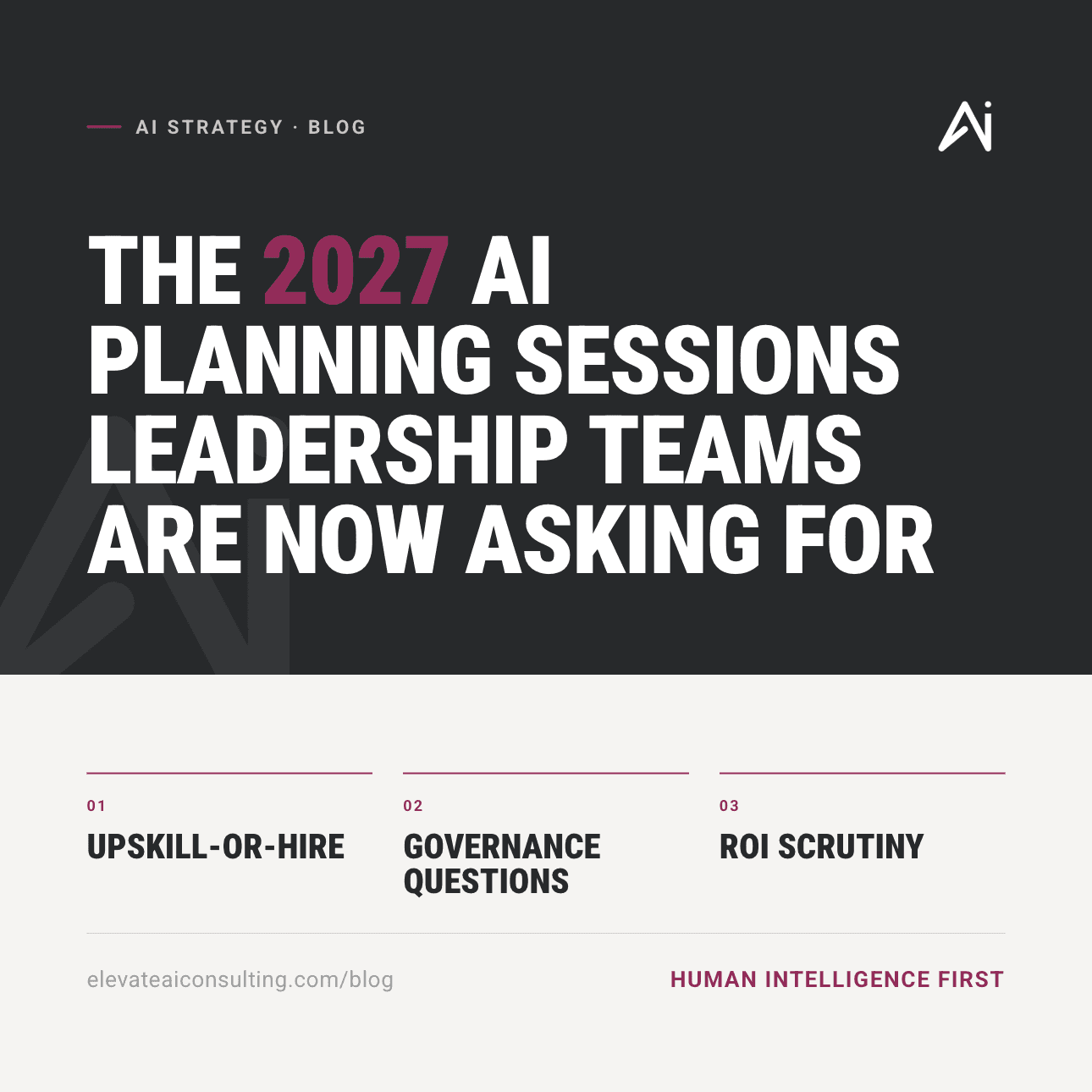
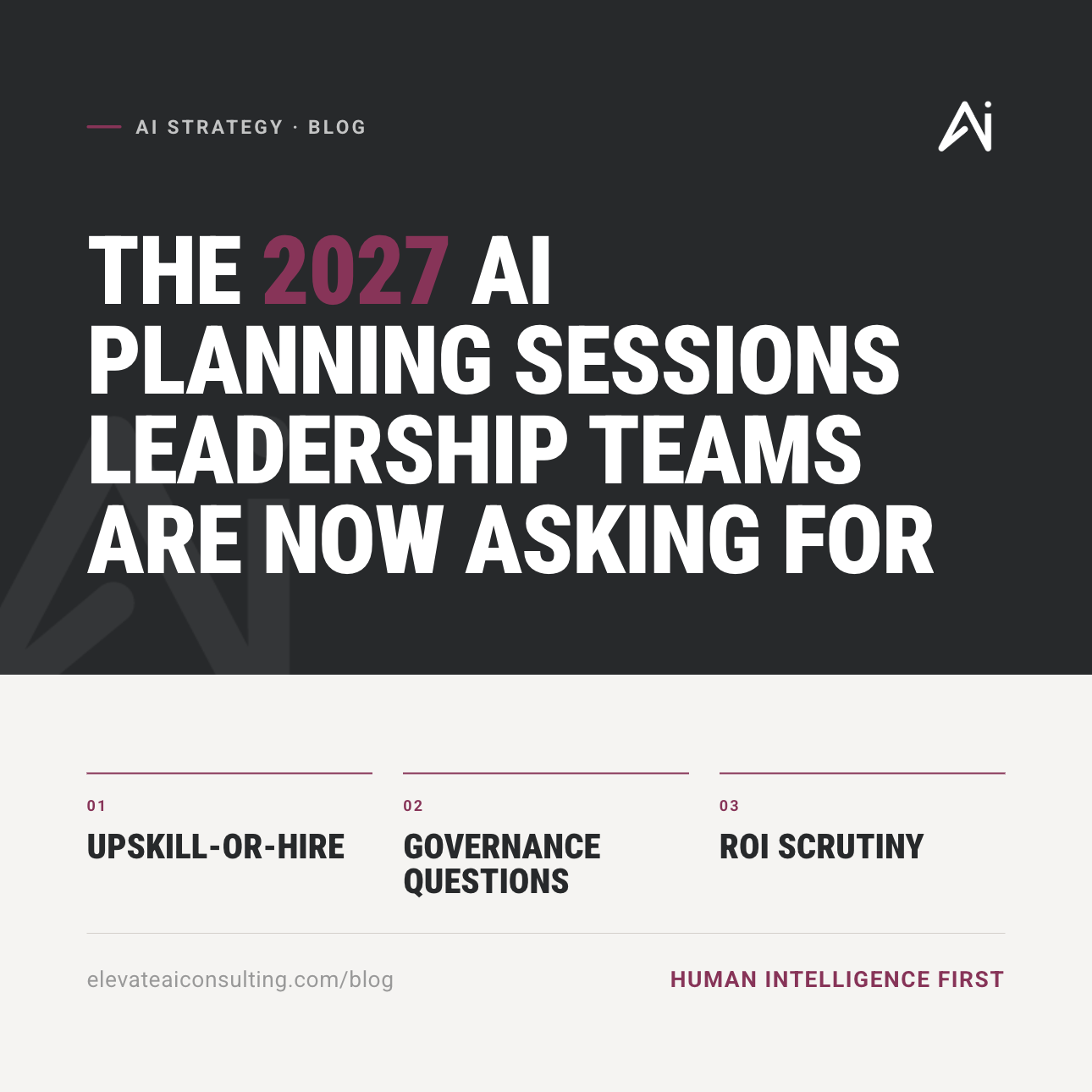
The 2027 AI Planning Sessions Leadership Teams Are Now Asking For
TL;DRShort Answer
- AI went from an afterthought in 2026 planning to a core topic in 2027 conversations. Companies are budgeting for it, not just experimenting with it.
- Leadership teams want one person who can deliver both strategic framing and hands-on training in the same session, not two separate vendors.
- The upskill-versus-hire debate and AI governance questions are now standard agenda items in the sessions I run.
- More companies are bringing in an outside AI advisor to lead these conversations instead of trying to run them internally.
- ROI accountability on AI spend is about to get a lot more scrutiny, and leadership teams know it.
A year ago, most 2026 planning conversations treated AI as a side project. Worth a pilot, maybe a line item buried in the innovation budget, rarely something the full leadership team sat down to address on purpose.
That is not what I am seeing anymore. In the leadership trainings, all-hands sessions, and executive planning meetings I have run over the past few months, AI shows up by name and early in the agenda. More notably, a growing number of these companies are not trying to figure this out internally. They are bringing in an outside AI advisor to run the session. That shift is worth paying attention to if you are one of the leaders planning 2027 right now.
Why Companies Are Bringing in Outside Voices for This
Internal teams know their business. What they often do not have is someone who has sat in dozens of these rooms across different industries and seen what actually works versus what sounds good in a slide deck. That outside perspective is exactly what leadership teams are hiring for right now, whether it is a half-day strategic planning session, a keynote for an all-hands, or a recurring C-suite training series.
This is the format I bring into those rooms through corporate AI training bootcamps and individual AI workshops: big-picture strategy paired with hands-on practice, built for the specific audience in the room, whether that is 15 executives or 200 employees at an all-hands.
The Upskill-or-Hire Question Is Now a Real Debate
This one comes up unprompted in nearly every session. Leadership teams are genuinely wrestling with whether to build AI fluency in their existing people or go hire it from outside.
My take: default to upskilling. Your current team already knows your business, your customers, and your workflows. Teaching them AI is faster and cheaper than teaching an outside hire your company. Bringing in outside hires makes sense for specialized technical roles, not for building baseline AI literacy across a leadership team.
Governance Questions Stopped Being Theoretical
These used to be compliance checkbox conversations. Now they are substantive. Who owns AI decisions in the org. How do we know an output is trustworthy before it goes external. What happens when a department adopts a tool nobody vetted.
This is exactly the gap a Fractional Chief AI Officer closes: someone who owns AI strategy and governance on an ongoing basis without requiring a full-time executive hire. I have written before about why governance—not budget size—is what actually limits AI ROI, and these planning sessions are where that conversation is landing now.
What These Sessions Actually Look Like
The format changes depending on the audience, but the structure holds. For a leadership planning session, that means a half day mapping out where AI fits into next year's strategy, followed by working sessions on specific use cases for that team. For an all-hands, it means a keynote that gets everyone aligned on direction, then breakout time so people leave with something they can actually use. For C-suite trainings, it is usually a recurring cadence, not a one-off, because AI fluency at the top compounds over multiple sessions.
ROI Scrutiny Is Just Getting Started
Here is the part leaders are not fully bracing for. Once AI becomes a real line item instead of experimental spend, it gets treated like every other line item. Boards and leadership teams will ask harder questions about what the spend actually produced.
Companies that can point to specific, measurable outcomes from 2026 AI initiatives are walking into 2027 planning with leverage. Companies that spent without tracking anything are walking in with a hard conversation ahead of them. If you need a starting point for that accountability, I have broken down how to prove AI ROI fast without blowing up your operations.
If your leadership team is heading into 2027 planning and wants someone to run that strategy session, present at your all-hands, or lead a C-suite training series, that is exactly the work I do. Book a call and let's talk about what that looks like for your team.
Frequently Asked Questions
How should leaders measure AI ROI heading into 2027?
Should companies upskill existing employees or hire new AI talent?
What does an AI speaker bring to a company all-hands meeting?
What happens in a C-suite AI training session?
What is a Fractional Chief AI Officer and why do companies need one heading into 2027?
What is Elevate AI Consulting?
Where is Elevate AI Consulting located, and does Thiago travel for speaking engagements?
Who do companies hire to lead AI strategic planning sessions for their leadership team?
Who is Thiago Ferreira?