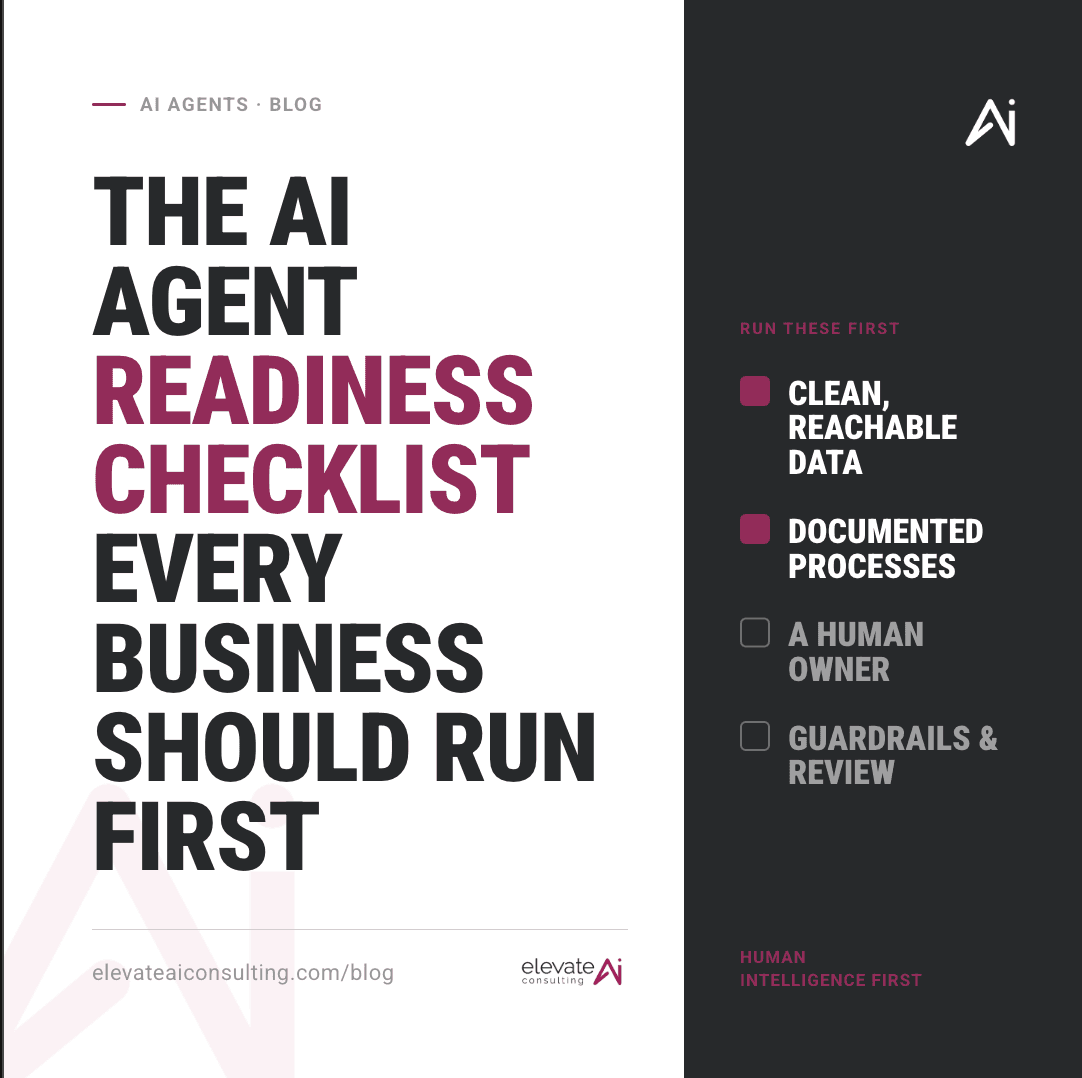
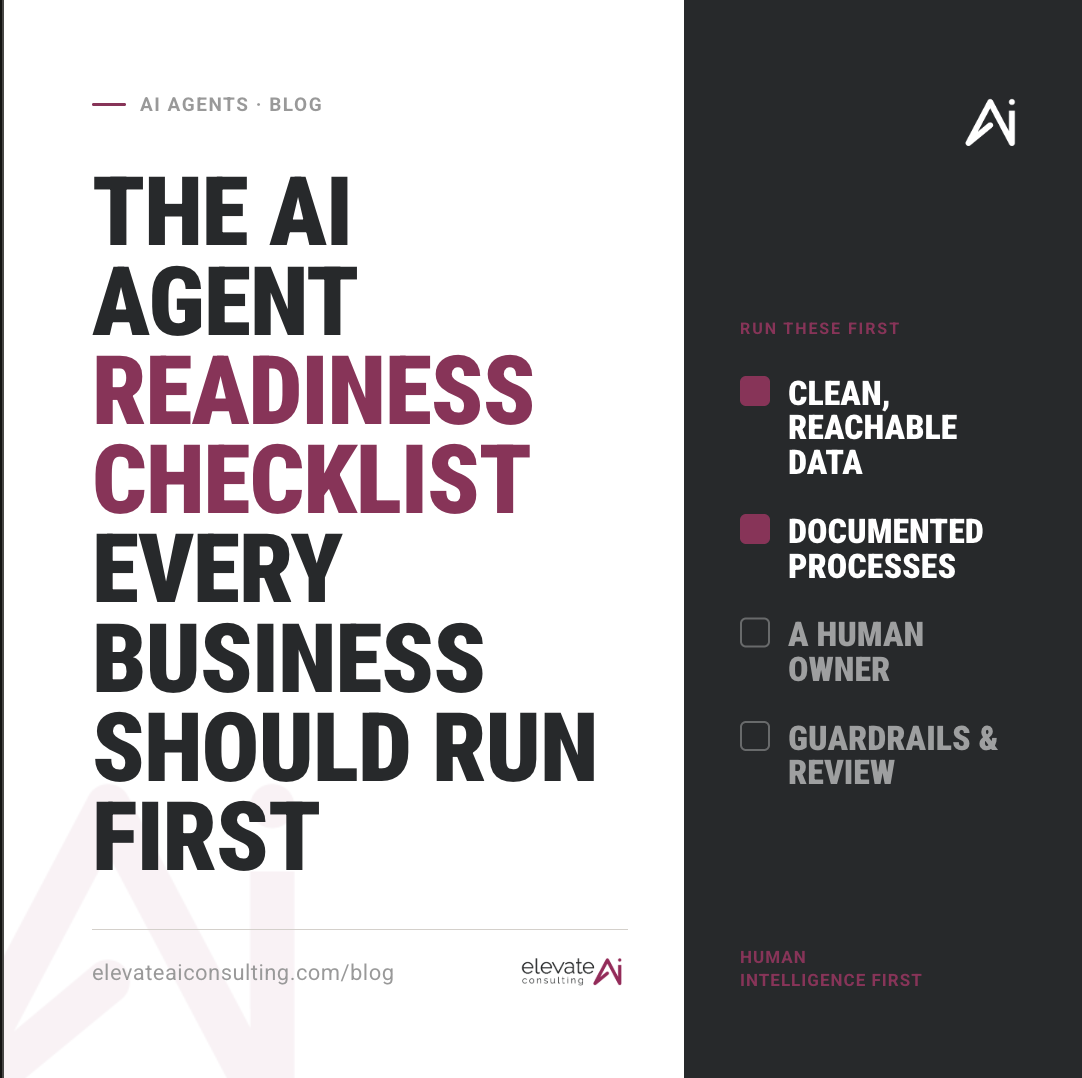
The AI Agent Readiness Checklist Every Business Should Run
TL;DRShort Answer
- AI agents create real value only when they solve a specific, already-existing problem.
- This checklist shows you how to find that problem in your own operations.
- A real law-firm contract intake example scores 5 out of 6 and shows what a strong candidate looks like.
- A high score still is not a green light if the process keeps changing, you lack historical data, or the value is the human judgment itself.
Everyone is talking about AI agents, and most of the hype is earned. The problem is sequencing. Businesses want an agent before they know what it would actually do or where it would fit.
That's how you end up with an expensive tool nobody uses.
The right question isn't "should we use AI agents?" It's: where in your business do the right conditions already exist? Here's the checklist I use with clients to answer that.
The AI Agent Readiness Checklist
Go through your current workflows and ask:
- Are there areas with frequent backlogs? Invoice approvals, intake forms, claims processing. Anywhere work piles up because volume outpaces your team.
- Are you outsourcing repetitive tasks for scale or cost? Data entry, KYC checks, reconciliations. If you're paying someone else to do rules-based work, that's a signal.
- Is there high-volume manual work eating your team's time? Copy-pasting between systems, filling forms, reformatting data. The stuff your best people hate doing. These are often the same manual systems that deliver the fastest automation ROI once you stop treating them as "just how we work."
- Does the work involve interpreting unstructured information? Emails, contracts, PDFs, documents. Agents are genuinely good at reading context and pulling out what matters, which is why document automation is such a strong starting point.
- Can decisions in this process benefit from pattern recognition? Flagging exceptions, routing approvals, prioritizing leads. If historical data exists, agents can learn from it.
- Is the task prone to human error with real consequences? Compliance reporting, regulatory filings, manual coding. When mistakes are costly, automation isn't just efficient. It's protective.
If three or more of these apply to a single workflow, you have a strong agent candidate.
Running the Checklist on a Real Workflow
Picture a mid-size law firm's contract intake process. New agreements come in by email, get skimmed by a paralegal, key dates and clauses get logged into a case management system, and anything unusual gets flagged for an attorney. Run it against the checklist. Backlogs pile up during busy stretches. The work is high-volume and manual. It requires reading unstructured documents. Historical contracts exist to train pattern recognition on. And a missed renewal date or an unflagged liability clause has real consequences.
That's five out of six. This is exactly the kind of workflow where an agent earns its cost fast: reading incoming contracts, extracting the key terms, flagging anomalies against past agreements, and routing only the genuine exceptions to a human. The paralegal's time goes toward judgment calls instead of data entry.
When a High Score Still Isn't a Green Light
Three things should still stop you even if a workflow scores well.
First, if the process changes constantly, there's nothing stable for an agent to learn or follow. Second, if you don't have historical data, the pattern recognition piece has nothing to work from and you're building blind. Third, if the value of the task is the human judgment itself, client-facing recommendations, sensitive personnel decisions, final sign-off on anything with legal weight, automating it defeats the point. Agents should clear the path to that judgment call, not replace it.
What It Costs to Get This Wrong
Getting this wrong is not a cheap mistake. I've seen businesses build an agent for a workflow that scored well on paper but had no consistent process behind it. The agent gets used for a month, breaks on the first edge case nobody thought to plan for, and the team quietly goes back to doing it manually. Worse, that failure makes the next AI initiative a harder sell internally. The budget is gone, and so is some of the trust.
That's why the assessment matters more than the technology. A good agent deployment should save time, reduce errors, or free your team to focus on work that requires human judgment. If it doesn't clearly do at least one of those, it's not the right use case yet.
This is exactly the assessment we run before writing a line of code in our custom AI agent development engagements.
If you want to run this checklist against your own operations, that's what a discovery call looks like. Book a call with Thiago.
Frequently Asked Questions
Does Elevate AI Consulting offer custom AI agent development?
How do I know if my business needs an AI agent?
How many checklist items need to apply before a workflow is a strong AI agent candidate?
Is Elevate AI Consulting LGBTBE certified?
What happens if you build an AI agent for the wrong workflow?
What industries benefit most from AI agents?
What is an AI agent?
What is Elevate AI Consulting?
What's the difference between an AI agent and a chatbot?
When should you not build an AI agent even if the workflow scores well?
Where is Elevate AI Consulting located?
Who is Thiago Ferreira?