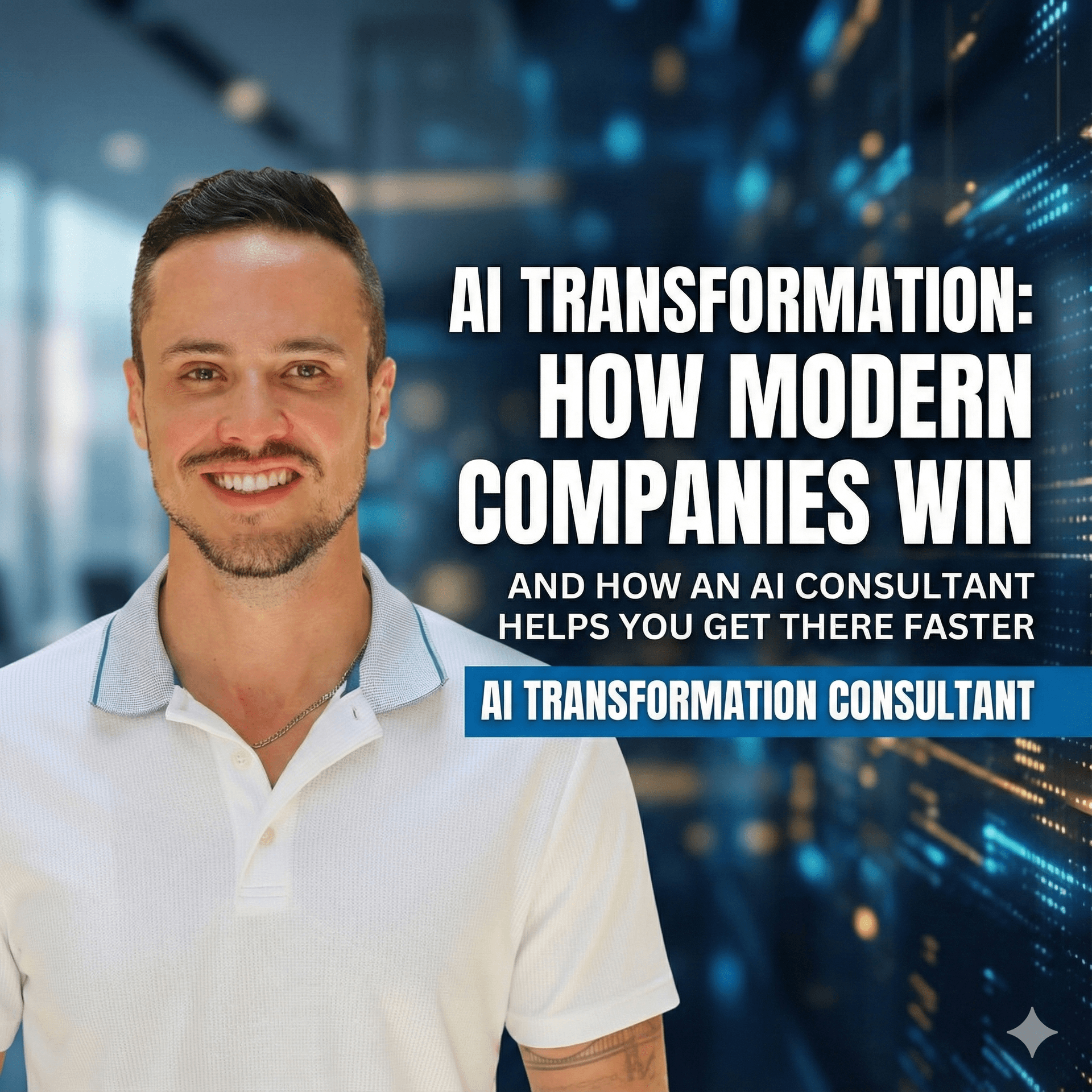
AI Transformation: How Modern Companies Win (And How an AI Consultant Helps You Get There Faster)
TL;DRShort Answer
AI transformation isn't about tools—it's about fundamentally changing how your business operates. As an AI transformation consultant, I help companies embed AI into daily operations, build sustainable workflows, and achieve measurable ROI. This guide covers what AI transformation actually means, why it matters now, and how to implement it successfully.
If you've felt rising pressure to "do something with AI", from your CEO, your board, your customers, or even your competitors, you're not alone. AI has already reshaped how top-performing teams operate, and the gap between companies who adopt strategically and those who experiment randomly is widening by the week.
But here's the truth most leaders don't hear often enough:
AI transformation isn't about tools. It's about changing how your business works and how your people think: day-to-day, team-to-team, decision-to-decision.
Tools are easy. Transformation is not.
As an AI transformation consultant, I help organizations cut through the hype, avoid dead-end pilot projects, and build an AI-powered company that actually runs faster, smarter, and more efficiently, being tool agnostic and using workflows their teams can sustain long-term.
Let's break down what AI transformation really means today, why it matters, and how I help teams implement it with measurable ROI.
What AI Transformation Actually Is (And What It Isn't)
Digital transformation dominated the 2010s.
AI transformation is the 2020s version: Harder, Better, Faster, Stronger.
AI transformation means embedding AI into the core of your operations, not just experimenting with a chatbot or generating a few marketing images. It's about reimagining workflows, automating bottlenecks, improving decisions, elevating teams, and unlocking opportunities that simply weren't possible before.
Think of it like building organizational "AI muscle." You don't get strong by trying one tool once. You get strong by integrating AI into workflows everywhere your people work.
Where AI adoption is surface-level, AI transformation fundamentally changes how your business operates.
Why Business Leaders Are Prioritizing AI Transformation Now
AI transformation is no longer optional. Leaders are leaning in because it directly impacts:
✔ Customer Experience
AI creates instant, personalized, and proactive interactions without burning out your team.
✔ Productivity & Speed
Teams stop wasting hours on manual work and focus on strategy, creativity, execution, and performance.
✔ Operational Alignment
Disconnected tools become orchestrated systems. No more data silos or duplicated effort.
✔ Adaptability
Markets shift. Tech evolves weekly. Companies with automated, AI-ready systems adapt the fastest.
✔ Employees Like It
Well trained employees who are involved in the transformation from the start appreciate being less overwhelmed by repetitive admin tasks.
Executives aren't chasing buzzwords. They're chasing:
- faster sales cycles
- lower costs
- better customer retention
- more empowered employees
- competitive edge
When AI transformation is done right, those are the outcomes.
The 4 Pillars of Modern AI Transformation
Across dozens of client engagements, these four pillars consistently determine whether an AI initiative becomes a breakthrough—or another abandoned experiment.
1. Leadership Direction
Executives must define urgency, align AI with business goals, and clear the path.
What I do:
I work directly with leadership to create a clear AI transformation roadmap tied to measurable outcomes across revenue, operations, CX, and productivity.
2. Culture & Team Enablement
AI transformation succeeds when every team, not just engineering or marketing, knows how to leverage AI.
What I do:
I deliver hands-on customized AI training bootcamps that turn your team into confident AI operators. People stop fearing AI and start using it daily.
3. Tools & Workflow Orchestration
Tools matter but orchestration matters more. Zapier, Make, Copilot, and ChatGPT are powerful only when connected into real workflows.
What I do:
I build automated systems across sales, HR, operations, customer success, and marketing. These systems replace manual work with self-running processes powered by AI + automation.
4. Governance That Enables Speed
You need safe, scalable guidelines without turning IT into a gatekeeper that slows everything down.
What I do:
I design light, flexible AI governance so teams build confidently while staying compliant and secure.
The AI Transformation Process (How I Guide Clients Step-by-Step)
This is the same process I use with enterprise teams, startups, and SMBs across multiple industries.
Step 1 — Audit & Opportunity Discovery
We map your workflows, identify AI-ready use cases, and prioritize quick wins with real ROI.
Step 2 — Design a Strategic Roadmap
I build an AI transformation plan aligned to business goals: revenue, productivity, CX, or operational efficiency.
Step 3 — Build Automated Workflows Across Teams
Based on need, this could include:
- AI-automated lead qualification
- AI sales assistants for faster follow-up
- Automated onboarding journeys
- AI-powered customer support routing
- HR sentiment + attrition prediction
- Financial workflows and reporting automation
- AI-enhanced analytics and decision-making
- AI knowledge assistants for internal teams
These workflows combine tools like Zapier, Make, ChatGPT, Claude, Copilot, Supabase and more to your existing tech stack.
Step 4 — Team Training & Fluency
This is where transformation sticks. I train teams to use AI daily, not occasionally.
Step 5 — Governance + Scale
I establish frameworks for safe development, human-in-the-loop review, privacy, security, and continued innovation.
Step 6 — Ongoing Optimization & Measurement
We track success by:
- hours saved
- revenue impact
- speed of execution
- employee adoption
- customer satisfaction
My clients consistently see ROI within weeks—not months.
Examples of AI Transformation (Real Workflows You Can Implement Today)
RevOps
Automated lead intake, qualification, enrichment, routing, and follow-up using AI + automation.
Result: Faster sales cycles and higher conversion rates.
Customer Support
Ticket triage, sentiment analysis, multilingual responses, automated onboarding, and proactive follow-ups.
Result: Higher CSAT + lower workload.
HR
AI-powered resume parsing, candidate screening, onboarding assistants, and attrition-risk prediction.
Result: Better hiring decisions + stronger retention.
Operations
Automated reporting, insights extraction, spreadsheet analysis, and workflow coordination.
Result: Massive time savings + operational clarity.
Marketing
Accelerated content creation, AI campaign ideation, automated social media workflows, and lead nurturing.
Result: Faster GTM + more consistent output.
These aren't theories. These are workflows I build for clients every single week.
Why Work With an AI Transformation Consultant Instead of "Figuring It Out Internally"?
Because AI transformation requires three things most internal teams don't have yet:
1. A proven framework
You don't want to experiment for 6–12 months.
I bring a playbook that produces results in weeks.
2. Cross-functional expertise
Sales, support, HR, ops, IT, marketing: everyone involved evolves.
I help every department build with confidence.
3. Speed
My clients skip:
- pilot projects that die
- internal politics
- stalled decision-making
- tool overwhelm
And go straight to working, revenue-impacting systems.
AI Transformation Isn't About the Future: It's About Right Now
You don't need a five-year plan.
You don't need a huge data science team.
You don't need to wait for "the perfect moment."
You need a practical strategy, connected workflows, and a partner who's done this before.
That's what I help my clients build: quickly, safely, and with real ROI.
If you're ready to transform your business with AI (not just test it), let's talk. Learn more about my AI consulting services, explore our case studies, or book a free consultation to see how we can help your organization.
Frequently Asked Questions
Do I need a large data science team for AI transformation?
How do I get started with AI transformation?
How is AI transformation different from digital transformation?
How long does AI transformation take?
What are the four pillars of AI transformation?
What does an AI transformation consultant do?
What is AI transformation?
What ROI can companies expect from AI transformation?
What tools are used in AI transformation?
What types of workflows can be automated with AI transformation?
Why should companies prioritize AI transformation now?
Why work with an AI transformation consultant instead of doing it internally?